
The Hero of This Book: A Novel

Estimated reading time: 2 minutes, 1 second

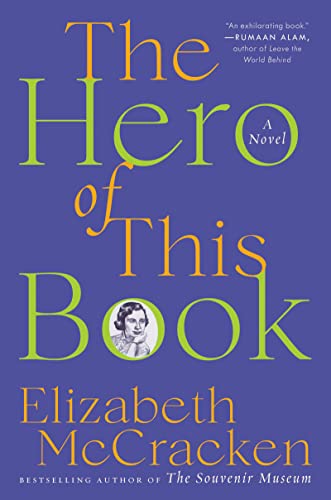
The Hero of This Book: A Novel by Elizabeth McCracken is a searing examination of grief and renewal and a deeply felt relationship between a child and her parents. It is not a memoir but a remembrance of those we have lost. Ten months after her mother’s death, the narrator of The Hero of This Book takes a trip to London. The city was a favorite of her mother’s, and as the narrator wanders the streets, she reflects on her mother’s life and their relationship.

Thoughts of the past meld with questions of the future: Back in New England, the family home is now up for sale, its considerable contents already winnowed.

The following quote resonated with me.

I’ve always hated the notion, in life or in fiction, that the human personality is a puzzle to be solved, that we are a single flashback away from understanding why this person is cruel to her children, why that man has a dreamy, downcast look. A human being is not a lock and the past is not a key.

I highly recommend this book.

The Goodreads summary provides an overview,

The woman, a writer, recalls all that made her complicated mother extraordinary–her brilliant wit, her generosity, her unbelievable obstinacy, her sheer will to seize life despite physical difficulties–and finds herself wondering how her mother had endured. Even though she wants to respect her mother’s nearly pathological sense of privacy, the woman must come to terms with whether making a chronicle of this remarkable life constitutes an act of love or betrayal.

The Hero of This Book is a searing examination of grief and renewal and a deeply felt relationship between a child and her parents. What begins as a question of filial devotion ultimately becomes a lesson in what it means to write. At once comic and heartbreaking, with prose that delights at every turn, this is a novel of such piercing love and tenderness that we are reminded that art is what remains when all else falls away.


The Jan Lilien Education Fund sponsors ongoing sustainability and environmental awareness programs. Gifts made this month; I will match dollar-for-dollar. All donations are tax-deductible.

Subscribe

Contact Us

I receive a commission when you buy a book or product using a link on this page. Thank you for supporting Sharing Jan’s Love blog.

The Jan Lilien Education Fund!

Great Expectations: A Novel

Read: March 2024

Get this book

Great Expectations: A Novel

by Vinson Cunningham

Today, I began reading “Great Expectations: A Novel” by Vinson Cunningham, a staff writer and theatre critic at The New Yorker. David, the protagonist, had seen the Senator speak a few times before my life got caught up, however distantly, with his. Still, the first time I can remember paying real attention was when he delivered the speech announcing his run for the Presidency.

Upon hearing the Senator from Illinois speak, David experiences conflicting emotions. He is fascinated by the Senator’s idealistic language yet ponders the balance between maintaining solid beliefs and making the necessary compromises to become America’s first Black president.

The book Great Expectations narrates David’s experience working for eighteen months on a Senator’s presidential campaign. During his journey, David encounters diverse individuals who raise questions about history, art, race, religion, and fatherhood. These inquiries prompt David to introspect his life and identity as a young Black man and father living in America.

Meditating on politics, religion, family, and coming-of-age, Great Expectations is a novel of ideas and emotional resonance, introducing a prominent new writer.

×
Corey Fah Does Social Mobility

Read: February 2024

Get this book

Corey Fah Does Social Mobility

by Isabel Waidner

Today, I began reading “Corey Fah Does Social Mobility: A Novel” by Isabel Waidner. The book is about Corey Fah, a writer whose novel has just won the Fictionalization of Social Evils prize. Despite this achievement, the trophy and funds with the award still need to be in reach. The novel celebrates radical queer survival and challenges false notions of success.

Corey, their partner Drew, and their pet spider, Bambi Pavok, embark on a quest to find an elusive trophy with neon-beige color and UFO-like qualities. This journey takes them back to their childhood in the forest and includes a stint on a reality TV show. While facing the horrors of wormholes and time loops, Corey discovers the difference between a prize and a gift in a complex way.

Following the Goldsmiths Prize–winning Sterling Karat Gold, Isabel Waidner’s bold and buoyant new novel is about coming into one’s own, the labor of love, the tendency of history to repeat itself, and what ensues when a large amount of cultural capital is suddenly deposited in a place it has never been before.

×
Grand Rapids: A Novel

Read: January 2026

Get this book

Grand Rapids: A Novel

by Natasha Stagg

Natasha Stagg‘s “Grand Rapids” is a coming-of-age story set in the Michigan suburbs in the early 2000s. Alexander Calder’s public sculpture, “La Grande Vitesse”, installed alongside the Grand River in downtown Grand Rapids, has become a symbol of the city. Tess moved there from Ypsilanti, Michigan, in 2001—the same year her mother passed away, marking the beginning of a time when everything felt like it was moving in slow motion for her.

Thrust into adolescence nearly rudderless, fifteen-year-old Tess is intoxicated, angsty, and sexually awake. A decade later, inspired by diary entries and TV reruns, she remembers this summer in the suburbs as the one that redefined her. Its echoes of death are frozen in time, like the waves represented in Calder’s sculpture or the concrete steps leading down to the churning river. She sees Grand Rapids as a collection of architecture and emblems, another home to which she cannot return.


Natasha Stagg is the author of Surveys: A Novel (2016), Sleeveless: Fashion, Image, Media, New York 2011–2019 (2019), and Artless: Stories 2019–2023 (2023). She lives in New York City.


Discover your next favorite book and dive into a world of curated, exciting reads by purchasing through my links. You’ll have access to a diverse selection of books that I’ve personally vetted to ensure quality and enjoyment. Additionally, by supporting these selections, you’ll help me continue to provide you with more personalized recommendations. I earn a small commission from your purchase, which allows me to buy and share even more books with you. Your support truly makes a difference!


×
Invisible Child

Read: December 2021

Get this book

Invisible Child: Poverty, Survival & Hope in an American City

by Andrea Elliott

Invisible Child: Poverty, Survival & Hope in an American City by Andrea Elliott was a gift from my son Jon. The New York Times selected “Invisible Child” as one of the best books published this year. It is indeed one of the top books on my all-time list.

GoodReads summary provides a good overview,

The riveting, unforgettable story of a girl whose indomitable spirit is tested by homelessness, poverty, and racism in an unequal America—from Pulitzer Prize-winning journalist Andrea Elliott of The New York Times

Invisible Child follows eight dramatic years in the life of Dasani Coates, a child with imagination as soaring as the skyscrapers near her Brooklyn homeless shelter. Born at the turn of a new century, Dasani is named for the bottled water that comes to symbolize Brooklyn’s gentrification and the shared aspirations of a divided city. As Dasani grows up, moving with her tight-knit family from shelter to shelter, this story goes back to trace the passage of Dasani’s ancestors from slavery to the Great Migration north. When Dasani comes of age, New York City’s homeless crisis explodes as the chasm deepens between rich and poor.

In the shadows of this new Gilded Age, Dasani must lead her seven siblings through a thicket of problems: hunger, parental drug addiction, violence, housing instability, segregated schools, and the constant monitoring of the child-protection system. When, at age thirteen, Dasani enrolls at a boarding school in Pennsylvania, her loyalties are tested like never before. As she learns to “code switch” between the culture she left behind and the norms of her new town, Dasani starts to feel like a stranger in both places. Ultimately, she faces an impossible question: What if leaving poverty means abandoning the family you love?

By turns heartbreaking and revelatory, provocative and inspiring, Invisible Child tells an astonishing story about the power of resilience, the importance of family, and the cost of inequality. Based on nearly a decade of reporting, this book vividly illuminates some of the most critical issues in contemporary America through the life of one remarkable girl.

Jan and I were involved and knew that child poverty and homelessness needed repair. In addition, Jan lived on Washington Park across from Ft. Greene Park in 1974-75. We knew the neighborhood where much of the book’s story takes place. 

Before meeting Jan in 1973, I was both a community/tenant organizer and a youth worker. In the latter role, I made weekly hostel trips for eight to ten young boys from East Williamsburg during 1973. The trips were the first the boys had ever been outside of their neighborhood.

Many of them had imaginations like Dasani. They also had her instinct to fight. One of my first tasks was to check for any weapons.

Decades later, when I would see any of them, now adults, they would ask when we were going on another trip. I wish I had met Jan when I made those trips. She would have helped me improve them and document the impact. If I could re-write history, I would have her join me as the second adult on the hostel trips.

After that summer, it was clear my primary skills were as a community/tenant organizer. Over the next few years, my work focused on creating affordable and supportive housing.

Jan and I did meaningful work that made a difference, yet the need for a permanent solution to the crisis remains. The book highlights the crucial role of resilience, the importance of family, and the cost of inequality. As a nation, we cannot undermine those values by breaking up families, impeding resilience, and maintaining racial and economic inequality. 

The current debate in Washington over the Build Back Better legislation needs to focus not on how much we spend but on its impact on children and families

David Brooks, a conservative commentator, has supported these expenditures for what they can do to address this country’s cultural and economic crisis. 

These packages say to the struggling parents and the warehouse workers: I see you. Your work has dignity. You are paving your way. You are at the center of our national vision.

This is how you fortify a compelling moral identity, which is what all of us need if we’re going to be able to look in the mirror with self-respect. This is the cultural transformation that good policy can sometimes achieve. Statecraft is soulcraft.

If you can only read one book this year, this is the one to read. Child poverty, homelessness, and inequality impact all of us. Ending child poverty and homelessness will make us a healthier and more inclusive nation. It is time for a compelling moral call to action!

Subscribe

Contact Us

When you buy a book or product using a link on this page, I receive a commission. Thank you for supporting Sharing Jan’s Love blog.

×
Everything's Fine

Read: June 2023

Get this book

Everything’s Fine

by Cecilia Rabess

I started reading Everything’s Fine by Cecilia Rabess today, a stunning debut introducing a talented new author. However, I found it easier to decide to read it after reading in the New York Times that some reviewers on Goodreads criticized the book’s premise without reading it. It’s unfair to criticize something after experiencing it first-hand.

On Jess’s first day at Goldman Sachs, she’s disappointed to learn that she’ll be working with Josh, a white conservative she used to argue with in college. Josh enjoys playing devil’s advocate and can be challenging to deal with.

But when Jess realizes she’s the only Black woman on the team and is being overlooked, Josh offers his support in imperfect but meaningful ways. As they develop an unlikely friendship with undeniable chemistry, it eventually becomes an electrifying romance that shocks them both.

Despite their differences, their attraction brings them together, and Jess starts to question whether happiness is more important than being right. However, as the cultural and political landscape shifts in 2016, Jess, who is just discovering herself, must decide what she’s willing to compromise for love and if everything is excellent. This poignant and sharp novel by Cecilia Rabess asks if they will and if they should.


The Jan Lilien Education Fund sponsors ongoing sustainability and environmental awareness programs. Gifts made this month; I will match dollar-for-dollar. All donations are tax-deductible.

Subscribe

Contact Us

I receive a commission when you buy a book or product using a link on this page. Thank you for supporting Sharing Jan’s Love blog.



×
Send for Me

Read: January 2022

Get this book

Send for Me

by Lauren Fox

Send for Me by Lauren Fox. Send for Me is an achingly beautiful work of historical fiction that moves between Germany on the eve of World War II and present-day Wisconsin, unspooling a thread of love, longing, and the constant push and pull of family. Annelise is a dreamer: imagining her future while working at her parents’ famous bakery in Feldenheim, Germany, anticipating all the delicious possibilities yet to come. There are rumors that anti-Jewish sentiment is on the rise, but Annelise and her parents can’t quite believe that it will affect them; they’re hardly religious at all. But as Annelise falls in love, marries, and gives birth to her daughter, the dangers grow closer: a brick was thrown through her window; a childhood friend who cuts ties with her; customers refuse to patronize the bakery.

This novel explores mothers and daughters, duty and obligation, hope and forgiveness of four generations of mothers and daughters – Klara, Annelise, Ruth, and Clare.

Klara is the matriarch who remains in Germany, where she dies at the beginning of the war. Annelise is her daughter who becomes a refugee in Milwaukee. The poignant letters from her mother ask for help to leave Germany and reunite with her daughter and granddaughter Ruthie, tying together the four generations.

The letters are found by Clara, who pays to have them translated. Can we ever escape from the past, and how does it shape our futures.

I enjoyed reading this book as I prefer historical fiction, especially about the rise of Germany and antisemitism.

Send for Me is also a reminder that we are refugees.

Our lives are forever intertwined between two cultures, the past and the future.

I highly recommend Send for Me.


Subscribe

Contact Us

When you buy a book or product using a link on this page, I receive a commission. Thank you for supporting Sharing Jan’s Love blog.
×