
Death Takes Me: A Novel

Estimated reading time: 2 minutes, 16 seconds

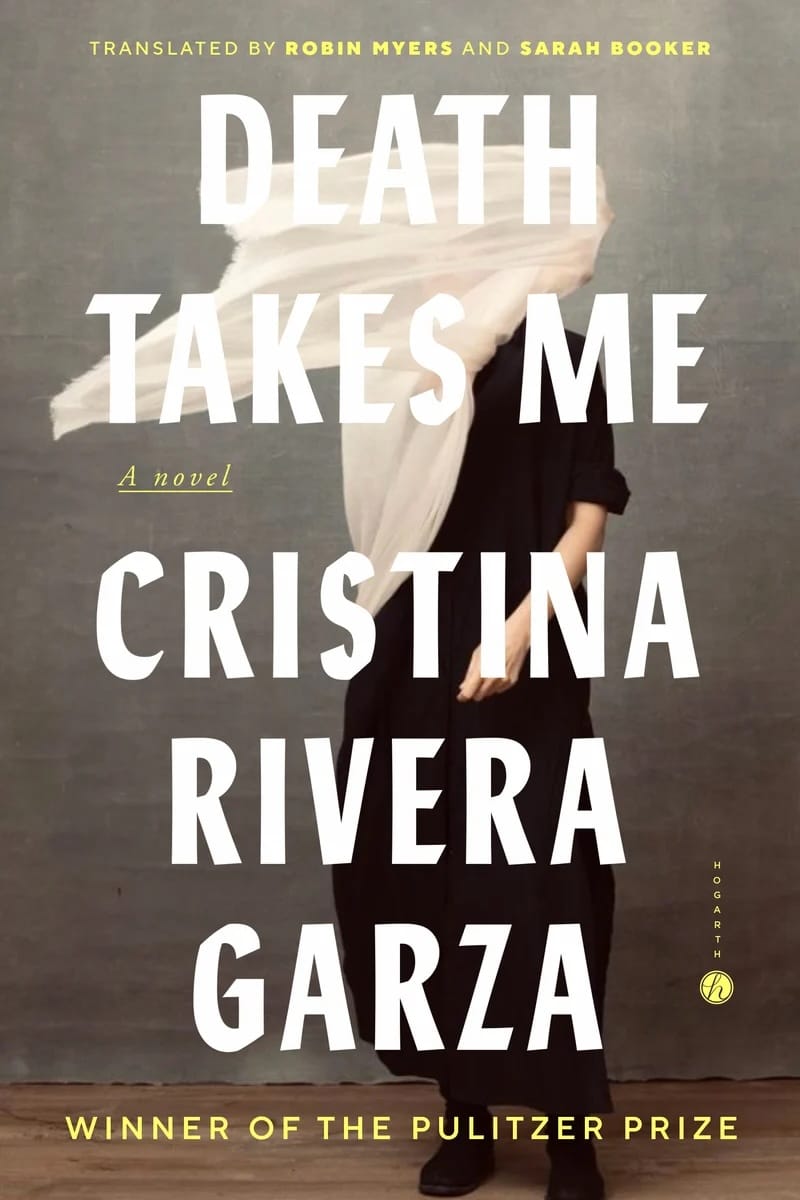
Originally written in Spanish by Cristina Rivera Garza, Death Takes Me is a thrilling masterpiece of literary fiction that turns the traditional crime narrative of gendered violence on its head. As sharp as the cuts on the bodies of the victims, the story unfolds with the dreamlike logic of a surreal experience, transitioning from the police station to a professor’s classroom and through the intricate worlds of Latin American poetry and art. It invites readers to explore the unstable terrains of desire and sexuality.

A city is always a cemetery.

In the narrative, a professor named Cristina Rivera Garza stumbles upon the corpse of a mutilated man in a dark alley and promptly reports it to the police. When shown a crime scene photo, she discovers a stark warning written in tiny print with coral nail polish on the brick wall beside the body: “Beware of me, my love / beware of the silent woman in the desert.”

The professor becomes the primary informant in the case, which is led by a detective who is newly obsessed with poetry and haunted by a list of past failures. But what has the professor truly witnessed? As more bodies of castrated men alongside lines of verse, the detective attempts to decipher the meaning of the poems in hopes of stopping the spreading violence throughout the city.


Cristina Rivera Garza is an acclaimed author known for works such as The Taiga Syndrome and The Iliac Crest. Her memoir, Liliana’s Invincible Summer, won the Pulitzer Prize and was a finalist for the National Book Award. She has received the MacArthur Fellowship and the Sor Juana Inés de la Cruz Prize. Currently, Rivera Garza holds the Hugh Roy and Lillie Cranz Cullen Distinguished Chair and serves as director of the PhD program in Creative Writing in Spanish at the University of Houston.

Sarah Booker is a teacher and a literary translator. Her translations include novels by Mónica Ojeda, Cristina Rivera Garza, and Gabriela Ponce. She is also an associate editor at Southwest Review.

Robin Myers is a poet and translator. Her translations encompass Andrés Neuman’s Bariloche, Claudia Peña Claros’s The Trees, Isabel Zapata’s In Vitro, Eliana Hernández-Pachón’s The Brush, and Cristina Rivera Garza’s The Restless Dead: Necrowriting and Disappropriation.


Discover your next favorite book and dive into a world of curated, exciting reads by purchasing through my links. You’ll have access to a diverse selection of books I’ve personally vetted for quality and enjoyment. Additionally, by supporting these selections, you’ll help me continue to provide you with more personalized recommendations. I earn a small commission from your purchase, which allows me to buy and share even more books with you. Your support truly makes a difference!


The Jan Lilien Education Fund!

Chess Story

Read: April 2026

Get this book

Chess Story: A Novella

by Stefan Zweig

Chess Story,” also known as “The Royal Game,” is the final work of Austrian author Stefan Zweig. He completed it while in exile in Brazil and sent it to his American publisher just days before his suicide in 1942. This story is unique as it is the only one in which Zweig directly examines Nazism, portraying it through his characteristic focus on psychological themes.

The narrative follows travelers aboard a ship bound for Buenos Aires, where they encounter an arrogant, unfriendly world chess champion. Attempting to challenge him, they find themselves thoroughly defeated. However, a mysterious passenger steps forward to offer them advice, dramatically shifting their fortunes. The story delves into how this enigmatic figure acquired his extraordinary chess skills and the personal toll that it entailed.

This new translation of “Chess Story” highlights the work’s distinctive blend of high suspense and poignant reflection.


Stefan Zweig (1881–1942), novelist, biographer, poet, and translator, was born in Vienna into a wealthy Austrian Jewish family. During the 1930s, he was one of the best-selling writers in Europe and was among the most translated German-language writers before the Second World War. With the rise of Nazism, he moved from Salzburg to London (taking British citizenship), to New York, and finally to Brazil, where he committed suicide with his wife. New York Review Books has published Zweig’s novels The Post-Office Girl and Beware of Pity, as well as the novella Chess Story.

Peter Gay was Director of the Center for Scholars and Writers at the New York Public Library. He wrote Schnitzler’s Century: The Making of Middle-Class Culture, 1815–1914.


Discover your next favorite book and dive into a world of curated, exciting reads by purchasing through my links. You’ll have access to a diverse selection of books I’ve personally vetted for quality and enjoyment. Supporting these selections not only helps me continue to provide you with personalized recommendations but also ensures you have access to meaningful stories that enrich your life. Your support truly makes a difference in helping me share more books and insights with you!


×
Invisible Child

Read: December 2021

Get this book

Invisible Child: Poverty, Survival & Hope in an American City

by Andrea Elliott

Invisible Child: Poverty, Survival & Hope in an American City by Andrea Elliott was a gift from my son Jon. The New York Times selected “Invisible Child” as one of the best books published this year. It is indeed one of the top books on my all-time list.

GoodReads summary provides a good overview,

The riveting, unforgettable story of a girl whose indomitable spirit is tested by homelessness, poverty, and racism in an unequal America—from Pulitzer Prize-winning journalist Andrea Elliott of The New York Times

Invisible Child follows eight dramatic years in the life of Dasani Coates, a child with imagination as soaring as the skyscrapers near her Brooklyn homeless shelter. Born at the turn of a new century, Dasani is named for the bottled water that comes to symbolize Brooklyn’s gentrification and the shared aspirations of a divided city. As Dasani grows up, moving with her tight-knit family from shelter to shelter, this story goes back to trace the passage of Dasani’s ancestors from slavery to the Great Migration north. When Dasani comes of age, New York City’s homeless crisis explodes as the chasm deepens between rich and poor.

In the shadows of this new Gilded Age, Dasani must lead her seven siblings through a thicket of problems: hunger, parental drug addiction, violence, housing instability, segregated schools, and the constant monitoring of the child-protection system. When, at age thirteen, Dasani enrolls at a boarding school in Pennsylvania, her loyalties are tested like never before. As she learns to “code switch” between the culture she left behind and the norms of her new town, Dasani starts to feel like a stranger in both places. Ultimately, she faces an impossible question: What if leaving poverty means abandoning the family you love?

By turns heartbreaking and revelatory, provocative and inspiring, Invisible Child tells an astonishing story about the power of resilience, the importance of family, and the cost of inequality. Based on nearly a decade of reporting, this book vividly illuminates some of the most critical issues in contemporary America through the life of one remarkable girl.

Jan and I were involved and knew that child poverty and homelessness needed repair. In addition, Jan lived on Washington Park across from Ft. Greene Park in 1974-75. We knew the neighborhood where much of the book’s story takes place. 

Before meeting Jan in 1973, I was both a community/tenant organizer and a youth worker. In the latter role, I made weekly hostel trips for eight to ten young boys from East Williamsburg during 1973. The trips were the first the boys had ever been outside of their neighborhood.

Many of them had imaginations like Dasani. They also had her instinct to fight. One of my first tasks was to check for any weapons.

Decades later, when I would see any of them, now adults, they would ask when we were going on another trip. I wish I had met Jan when I made those trips. She would have helped me improve them and document the impact. If I could re-write history, I would have her join me as the second adult on the hostel trips.

After that summer, it was clear my primary skills were as a community/tenant organizer. Over the next few years, my work focused on creating affordable and supportive housing.

Jan and I did meaningful work that made a difference, yet the need for a permanent solution to the crisis remains. The book highlights the crucial role of resilience, the importance of family, and the cost of inequality. As a nation, we cannot undermine those values by breaking up families, impeding resilience, and maintaining racial and economic inequality. 

The current debate in Washington over the Build Back Better legislation needs to focus not on how much we spend but on its impact on children and families

David Brooks, a conservative commentator, has supported these expenditures for what they can do to address this country’s cultural and economic crisis. 

These packages say to the struggling parents and the warehouse workers: I see you. Your work has dignity. You are paving your way. You are at the center of our national vision.

This is how you fortify a compelling moral identity, which is what all of us need if we’re going to be able to look in the mirror with self-respect. This is the cultural transformation that good policy can sometimes achieve. Statecraft is soulcraft.

If you can only read one book this year, this is the one to read. Child poverty, homelessness, and inequality impact all of us. Ending child poverty and homelessness will make us a healthier and more inclusive nation. It is time for a compelling moral call to action!

Subscribe

Contact Us

When you buy a book or product using a link on this page, I receive a commission. Thank you for supporting Sharing Jan’s Love blog.

×
Conjure Women

Read: November 2021

Get this book

Conjure Women: A Novel

by Afia Atakora

Conjure Women by Afia Atakora is about a mother and her daughter with a shared talent for healing—and for the conjuring of curses — at the heart of this dazzling first novel. Conjure Women takes place before, during, and after the Civil War. The book is structured around three-time frames; Slaverytime, Freddomtime, and Wartime.

Having grown up in the South and heard far too many stories about the Lost Cause, it was a joy to read a book narrated by two African-American women. The third leading character is the daughter o the owner of the plantation. At the end of the war, she was hidden away for six years and was unaware the South had surrendered.

Conjure Women is a sweeping story that brings the world of the South before and after the Civil War vividly to life. Spanning eras and generations, it tells of the lives of three unforgettable women: Miss May Belle, a wise healing woman; her precocious and observant daughter Rue, who is reluctant to follow in her mother’s footsteps as a midwife; and their master’s daughter Varina. The secrets and bonds among these women and their community come to a head at the beginning of a war and at the birth of an accursed child, who sets the townspeople alight with fear and a spreading superstition that threatens their newly won, tenuous freedom.

Magnificently written, brilliantly researched, and richly imagined, Conjure Women moves back and forth in time to tell the haunting story of Rue, Varina, and May Belle, their passions and friendships, and the lengths they will go to save themselves and those they love.

Since Jan died, I have read many books that I know she enjoyed. We both enjoyed Call the Midwife, and this book focused on birthing and mothering. Although conjuring was their medical care and not the type practiced in poplar by the Midwives, we would both have enjoyed the book.

Conjure Women also raises questions about the meaning of freedom. For example, Rue chooses not to leave the former plantation after the Klan attacks despite being free.

I recommend this book and look forward to reading more from Afia Atakora.

Subscribe

Contact Us

When you buy a book or product using a link on this page, I receive a commission. Thank you for supporting Sharing Jan’s Love blog.

×
Black Sun

Read: November 2021

Get this book

Black Sun – Between the Earth and Sky

by Rebecca Roanhorse

Black Sun by Rebecca Roanhorse.  Black Sun is the first book in the Between Earth and Sky trilogy, inspired by the civilizations of the Pre-Columbian Americas and woven into a tale of celestial prophecies, political intrigue, and forbidden magic.

I have always enjoyed fantasy novels like Black Sun, and this is the first one set in the Pre-Columbian Americas.

A god will return
When the earth and sky converge
Under the black sun

In the holy city of Tova, the winter solstice is usually a time for celebration and renewal, but this year, it coincides with a solar eclipse, a rare celestial event proscribed by the Sun Priest as an unbalancing of the world.

Meanwhile, a ship launches from a distant city bound for Tova and set to arrive on the solstice. The captain of the ship, Xiala, is a disgraced Teek whose song can calm the waters around her as quickly as it can warp a man’s mind. Her ship carries one passenger. Described as harmless, the passenger, Serapio, is a young man, blind, scarred, and cloaked in destiny. As Xiala well knows, when a man is described as harmless, he usually ends up being a villain.

Will Serapio be harmless or a villain? The answer, my friend, will be known when you read this book or perhaps the second one in the trilogy.

Before meeting and falling forever in love with Jan, I had dreamed of the life of an American Studies professor. Thousands of students are relieved to know I did not pursue that life. If I had opened that door, an area of focus would have been on Pre-Columbian Americas.

I recommend this book and will read the next two in the Between Earth and Sky trilogy.

Subscribe

Contact Us

When you buy a book or product using a link on this page, I receive a commission. Thank you for supporting Sharing Jan’s Love blog.

×
A Parish Chronicle

Read: February 2026

Get this book

A Parish Chronicle

by Halldór Laxness

In “A Parish Chronicle,” celebrated novelist Halldór Laxness weaves an essayistic tale about the unlikely miracles that keep a church—destined to disappear time and again—rooted on the same hillside. Laxness explores the minutiae of history, from the location of the ancient burial mound of national hero Egill Skallagrímsson to the end of the 19th century, where weak-sighted Ólafur and boisterous farmhand Gunna each play unexpected roles in the parish’s enduring survival.

1882. In the still of morning, Ólafur sharpens his scythe on the bone-dry pavestones that separate his farmhouse from the rest of Mosfell Valley, where life revolves around sheep. The sound of his hammer rings out like a high-pitched bell over the tussocky fields. Across the valley, perched on a hill that receives more sunshine than others, stands Mosfell Church. Nearby, the parish priest’s maid Gunna pours her “slosh,” a weak cup of coffee. Further afield in Reykjavík (“down south” as the locals say), the general assembly decides to revisit an old plan to cut costs by consolidating small parishes and calls for the demolition of Mosfell. Yet today a church stands on that same hillside—its sharp steeple silhouetted against the clouds, its crown bell hanging to the left of the altar.

This intimate tribute to life in Laxness‘s home valley also offers a thoughtful commentary on how the peculiarities of certain individuals can shape history. “A Parish Chronicle” is rich with life and detail.


Halldór Laxness (1902-1998) is the undisputed master of modern Icelandic fiction. He was awarded the Nobel Prize in Literature in 1955, “for his vivid epic power which has renewed the great narrative art of Iceland.” His body of work includes novels, essays, poems, plays, stories, and memoirs: more than sixty books in all. His works available in English include Independent People, The Fish Can Sing, World Light, Under the Glacier, Iceland’s Bell, and Paradise Reclaimed.

Philip Roughton has translated the work of Halldór Laxness, Jón Kalman Stefánsson, Kristín Marja Baldursdóttir, and many others. He has twice been awarded the American-Scandinavian Foundation Translation Prize for his renderings of Halldór Laxness‘s work, in 2001 for Iceland’s Bell and in 2015 for Wayward Heroes. He also received the 2016 Oxford-Weidenfeld Prize for his translation of Jón Kalman Stefánsson’s The Heart of Man. He lives in Iceland. Translator Residence: Akureyri, Iceland

Salvatore Scibona is the recipient of a Mildred and Harold Strauss Living Award from the American Academy of Arts and Letters. His first novel, The End, was a finalist for the National Book Award and winner of the Young Lions Fiction Award. His second novel, The Volunteer, was called a “masterpiece” by the New York Times and won the Ohioana Book Award. His books have been translated into ten languages. His work has won a Guggenheim Fellowship, a Pushcart Prize, an O. Henry Award, and a Whiting Award, and the New Yorker named him one of its “20 Under 40” fiction writers. He is the Sue Ann and John Weinberg Director of the Cullman Center for Scholars and Writers at the New York Public Library.


Discover your next favorite book and dive into a world of curated, exciting reads by purchasing through my links. You’ll have access to a diverse selection of books I’ve personally vetted for quality and enjoyment. Additionally, by supporting these selections, you’ll help me continue to provide you with more personalized recommendations. I earn a small commission from your purchase, which allows me to buy and share even more books with you. Your support truly makes a difference!

×
How the Word is Passed

Read: December 2021

Get this book

How the Word Is Passed: A Reckoning with the History of Slavery Across America

by Clint Smith

How the Word Is Passed: A Reckoning with the History of Slavery Across America by Clint Smith. This book was a gift from my son Jon. The New York Times selected How the Word is Passed as one of the best books published this year. Beginning in his hometown of New Orleans, Clint Smith leads the reader on an unforgettable tour of monuments and landmarks—those that are honest about the past and those that are not—that offer an intergenerational story of how slavery has been central in shaping our nation’s collective history, and ourselves.

How the Word is Passed is one of the best books I have read in 2021. I had read an excerpt in The Atlantic on the Whitney Plantation, one of the only former plantations devoted to preserving the experience of the enslaved people whose lives and work sustained it. Like most of us, I had placed the book on my to-read list, where it remained lost in the cobwebs. Fortunately, my son Jon purchased the book for me.

Secondly, the book rekindled my long-lost dream of being an American Studies professor. As soon as Jan and I met, I dropped plans to leave Brooklyn and start graduate school in the fall of 1974. I made that decision primarily because of how much I loved Jan. But it was also partly that I did not have a clear vision of what my life would be like as a professor. The book provided clear examples of people like Yvonne Holden at The Whitney Plantation redefining history to be more accurate and inclusive. I probably could not have done as well as she did, but I can now see that it might have resulted in a career for me that could have been impactful.

Goodreads provides this overview for those who still need to be convinced to read this book.

It is the story of the Monticello Plantation in Virginia, the estate where Thomas Jefferson wrote letters espousing the urgent need for liberty while enslaving over 400 people on the premises. It is the story of the Whitney Plantation, one of the only former plantations devoted to preserving the experience of the enslaved people whose lives and work sustained it. It is the story of Angola Prison in Louisiana, a former plantation named for the country from which most of its enslaved people arrived and which has since become one of the most gruesome maximum-security prisons in the world. And it is the story of Blandford Cemetery, the final resting place of tens of thousands of Confederate soldiers.

In a deeply researched and transporting exploration of the legacy of slavery and its imprint on centuries of American history, How the Word Is Passed illustrates how some of our country’s most essential stories are hidden in plain view-whether in places we might drive by on our way to work, holidays such as Juneteenth, or entire neighborhoods—like downtown Manhattan—on which the brutal history of the trade in enslaved men, women and children has been deeply imprinted.

Informed by scholarship and brought alive by the story of people living today, Clint Smith’s debut work of nonfiction is a landmark work of reflection and insight that offers a new understanding of the hopeful role that memory and history can play in understanding our country.

How the Word is Passed is one of the best books I have read this year and many prior ones. I encourage you to read it and share your comments.

Subscribe

Contact Us

When you buy a book or product using a link on this page, I receive a commission. Thank you for supporting Sharing Jan’s Love blog.

×