New Book: When We Cease to Understand the World

Estimated reading time: 0 minutes, 0 seconds
When We Cease to Understand the World

When We Cease to Understand the World

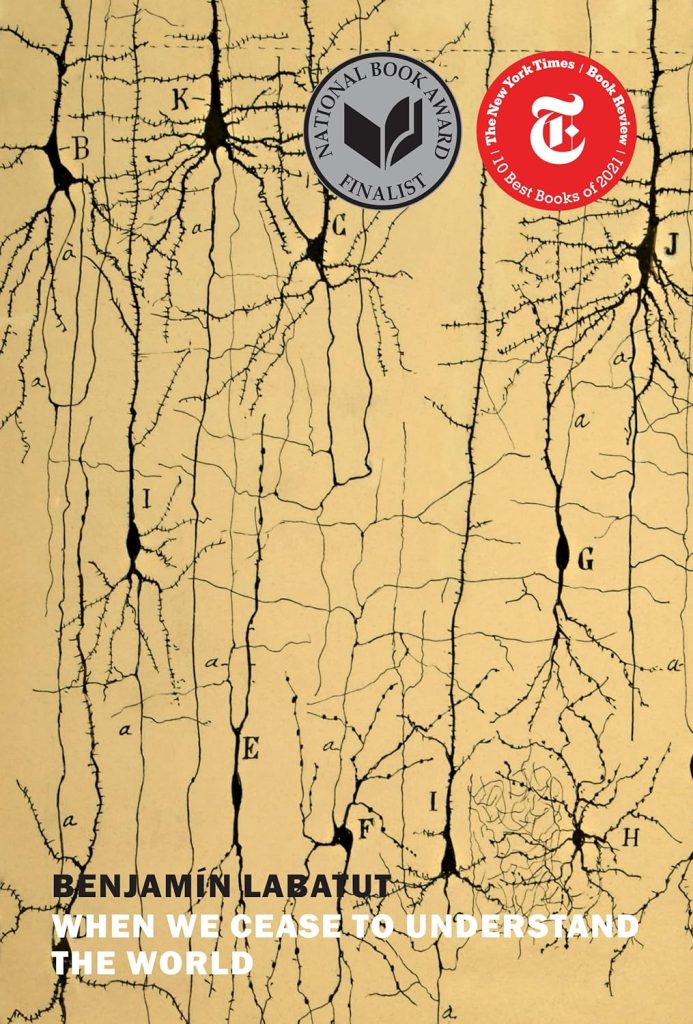
Today, I began reading When We Cease to Understand the World by Benjamín Labatut, translated by Adrian Nathan West. This book, listed on The New York Times 100 Best Books of the 21st Century, promises to be thought-provoking as it delves into the intricate connections between scientific and mathematical discovery, madness, and destruction.

Read book review Get this book All books

Share your thoughts and ideas

This site uses Akismet to reduce spam. Learn how your comment data is processed.

The Jan Lilien Education Fund!

When We Cease to Understand the World

Read: September 2024

Get this book

When We Cease to Understand the World

by Benjamín Labatut

Today, I began reading When We Cease to Understand the World by Benjamín Labatut, translated by Adrian Nathan West. This book, listed on The New York Times 100 Best Books of the 21st Century, promises to be thought-provoking as it delves into the intricate connections between scientific and mathematical discovery, madness, and destruction.

In a world where scientific advancements often involve ethical dilemmas and societal implications, this book offers a unique perspective on the lives of scientists who have shaped our understanding of the world. Fritz Haber, Alexander Grothendieck, Werner Heisenberg, and Erwin Schrödinger are some of the luminaries whose troubled lives Benjamín Labatut deeply explores in his fictional examination. Labatut shows how these scientists and thinkers grappled with profound questions of existence, experiencing strokes of unparalleled genius, alienating friends and lovers, and descending into isolation and insanity. Their discoveries, some of which significantly improved human life, while others led to chaos and unimaginable suffering, continue to shape our world.

With a breakneck pace and a wealth of disturbing detail, Labatut uses fiction’s imaginative resources to tell the stories of the scientists and mathematicians who expanded our notions of the possible.

×
The Annual Banquet of the Gravediggers' Guild

Read: January 2024

Get this book

The Annual Banquet of the Gravediggers’ Guild

by Mathias Énard

Today, I started reading “The Annual Banquet of the Gravediggers’ Guild” by Mathias Énard. The book has been translated into English by Frank Wynne. This novel is full of Mathias Énard‘s characteristic humor and extensive knowledge. It is a lively book where the boundaries between past and present are constantly blurred, set against a backdrop of excess reminiscent of Rabelais’ writing.

David Mazon, an anthropology student, moves from Paris to La Pierre-Saint-Christophe, a village in the marshlands of western France, to research his thesis on contemporary agrarian life. He is determined to understand the essence of the local culture and spends his time scurrying around on his moped to interview the residents.

David must be made aware of the extraordinary events in an ordinary location. This place, where wars and revolutions once occurred, is now a dancefloor for Death. When something dies, its soul is recycled by the Wheel of Life and thrown back into the world as a microbe, human, or wild animal – sometimes in the past and sometimes in the future. Once a year, Death and the living agree to a temporary truce, during which gravediggers indulge in a three-day feast filled with food, drink, and conversation.

Mathias Énard’s novel, The Annual Banquet of the Gravediggers’ Guild, is a riotous and exciting comic masterpiece that won the prestigious Prix Goncourt award. The novel is set in the French countryside and is filled with Énard’s characteristic wit and encyclopedic brilliance. Against a backdrop of excess, the story blurs the lines between past and present, creating a Rabelaisian world of chaos and humor.


The Jan Lilien Education Fund sponsors ongoing sustainability and environmental awareness programs. Gifts made this month; I will match dollar-for-dollar. All donations are tax-deductible.

Subscribe

Contact Us

I receive a commission when you buy a book or product using a link on this page. Thank you for supporting Sharing Jan’s Love blog.


×
The Corrections: A Novel

Read: September 2024

Get this book

The Corrections: A Novel

by Jonathan Franzen

Today, I embarked on a profound exploration of the human condition through Jonathan Franzen‘s ‘The Corrections: A Novel.’ It guides us from the heart of the Midwest in the mid-century to the bustling streets of Wall Street and the enigmatic landscapes of Eastern Europe. It’s no surprise that it’s hailed as one of The New York Times 100 Best Books of the 21st Century.

Jonathan Franzen‘s ‘The Corrections: A Novel‘ is not just a family saga but a profound critique of our modern society. It’s a work of art that delves into the issues of our new century, enlightening us with its insights. Franzen masterfully juxtaposes the old-fashioned America of freight trains, civic responsibility, and holiday treats with the modern absurdities of neuroscience, home surveillance, hands-off parenting, DIY mental health care, and the anti-gravity New Economy. It’s a narrative that will evoke laughter, tears, and deep contemplation. Through ‘The Corrections,’ Franzen establishes himself as one of the leading interpreters of American society and the American spirit.

Enid Lambert is distraught. She conceals her anxiety from her neighbors and adult children, but her husband, Alfred, is slipping into a world of his own. Whether it’s the medication for his Parkinson’s disease or his pessimism, he’s becoming increasingly detached. His days are spent brooding in the basement, engaging in mysterious, unsettling actions, and struggling to understand Enid’s words. The depth of their struggle is palpable, drawing the reader into their world.

Trouble also brews in the lives of Enid’s children. Her eldest son, Gary, a banker in Philadelphia, has become callous and materialistic, trying to push his parents out of their old home and into a small apartment. The middle child, Chip, has abruptly quit his exciting job as a professor at D—— College for no discernible reason. He moved to New York City, seemingly embracing a “transgressive” lifestyle while working on a screenplay. Meanwhile, the youngest, Denise, has left her disastrous marriage only to waste her youth and beauty on an affair with a married man—or so Gary implies.

Enid, a lover of life’s pleasures, still looks forward to a final family Christmas and the upcoming Nordic Pleasurelines Luxury Fall Color Cruise with Alfred. However, his growing confusion and instability threaten these remaining joys. As Alfred’s condition worsens, the Lamberts must confront their family’s past failures, secrets, and long-buried wounds. Yet, in this journey of confrontation and reconciliation, the hope for a better future emerges.

×
The Searcher: A Novel

Read: March 2024

Get this book

The Searcher: A Novel

by Tana French

Today, I started reading Tana French‘s The Searcher: A Novel. Last week, I read The Hunter by the same author. I should have read The Searcher first, as it is the prequel to The Hunter, but reading in reverse order helped my enjoyment. Despite knowing some of the suspenseful twists and turns the story would take, I found it a page-turner.

The story follows Cal Hooper, a retired Chicago police officer who seeks a fresh start in a tranquil Irish village. However, when a local boy approaches him to investigate his missing brother, Cal discovers that the town has its share of dark secrets. The book raises thought-provoking questions about distinguishing right from wrong in a complicated world and what we risk when making that decision.

Tana French is a highly acclaimed crime novelist who skillfully creates a captivating and suspenseful atmosphere throughout the book.

×
The Candy House

Read: December 2022

Get this book

The Candy House: A Novel

by Jennifer Egan

The Candy House: A Novel by Jennifer Egan focuses on a new technology that allows you access to every memory you’ve ever had and to share your memories in exchange for access to the memories of others—it has seduced multitudes. According to the NYTimes, “this is minimalist maximalism. As a widow, I live in a world of memories, but I would not want them shared as they are in The Candy House. “It’s as if Egan compressed a big 19th-century novel onto a flash drive.”

Of course, I am not able to access my unconscious memories. Albeit in an amateur way, I write down some of my memories as they remind me of the power of the love that Jan and I shared. For example, the essay when I met Jan rekindles the memory and attempts to tell the story the way it happened, not how some would like it to be remembered.

The Candy House is one of the NYTimes’ top five fiction books of 2022. I have read two of them, The Furrows and Checkout 19. Initially, I was overwhelmed by the multitude of characters and was confused. By the novel’s middle, their interconnectedness helped me understand its real meaning. In the end, Egan delivers a fierce and exhilarating testament to the tenacity and transcendence of human longing for authentic connection, love, family, privacy, and redemption. As a widow, authenticity Is what I need to heal.

The Candy House is the seventieth (70) book I have read this year. 

The Goodreads summary provides an overview.

It’s 2010. Staggeringly successful and brilliant tech entrepreneur Bix Bouton is desperate for a new idea. He’s forty, with four kids, and restless when he stumbles into a conversation with mostly Columbia professors, one of whom is experimenting with downloading or “externalizing” memory. Within a decade, Bix’s new technology, Own Your Unconscious—that allows you access to every memory you’ve ever had and to share every memory in exchange for access to the memories of others—has seduced multitudes. But not everyone.

In spellbinding linked narratives, Egan spins out the consequences of Own Your Unconscious through the lives of multiple characters whose paths intersect over several decades. Egan introduces these characters in an astonishing array of styles—from omniscient to first person plural to a duet of voices, an epistolary chapter, and a chapter of tweets. In the world of Egan’s spectacular imagination, there are “counters” who track and exploit desires and “eluders” who understand the price of taking a bite of the Candy House.

Intellectually dazzling and extraordinarily moving, The Candy House is a bold, brilliant imagining of a world that is moments away. With a focus on social media, gaming, and alternate worlds, you can almost experience moving among dimensions in a role-playing game.​ Egan delivers a fierce and exhilarating testament to the tenacity and transcendence of human longing for real connection, love, family, privacy, and redemption.


The Jan Lilien Education Fund sponsors ongoing sustainability and environmental awareness programs. Gifts made this month; I will match dollar-for-dollar. All donations are tax-deductible.

Subscribe

Contact Us

I receive a commission when you buy a book or product using a link on this page. Thank you for supporting Sharing Jan’s Love blog.


×
Aftermirth

Read: August 2022

Get this book

Aftermirth by Hillary Jordan

by Hillary Jordan

Aftermirth by Hillary Jordan is a book about grief as the two protagonists take a road trip that is a darkly funny journey of healing that takes them deep into the heart of their suffering and others, and then beyond it, to a place of peace and laughter. I had just finished reading When She Woke by Ms. Jordan and having enjoyed that book, reading a second one by the same author seemed reasonable.

When I selected this short novel to read, I questioned if it was a good choice for me.

I found it easier to read and, in some ways, helpful. It was like meeting fellow widows from my Zoom grief groups in person at Camp Widow. The ability to laugh about our loss and cry openly is essential to meeting fellow benefits.

Michael Larssen, the narrator, raised a question I have not and still do not want to consider. What if I am still alive, Jan was a great love but is not the love of my life?

“You can’t know that he was the love of your life, and do you know why? Because guess what, you aren’t dead yet. You may feel dead right now, and believe me I’ve been there, but the fact is, until you’re lying under a tombstone of your own you can’t be sure about anything. You could prick your finger on one of your roses tomorrow, and as you’re climbing the stairs to get a Band-Aid, you trip over one of the pugs and tumble to your death. Or you could meet a man in the checkout line at the grocery store–hell, you could meet a woman even and fall madly in love with her and end up with six kids and twenty grandkids. Michael looks over at Elena, then back at George. You just don’t know, George. That’s the thing. None of us does.”— Aftermirth (Kindle Single) by Hillary Jordan

Despite my anxiety about considering this disturbing question, I highly recommend Aftermirth by Hillary Jordan.

The Goodreads summary provides an overview.

I stopped being funny the day my wife was electrocuted by her underwire bra.” So begins “Aftermirth,” a dark comedy that explores the absurdity of death through the eyes of thirty-one-year-old comedian, writer, and actor Michael Larssen. What is funny to the rest of the world is devastating to Michael, who loves his wife deeply, exceptionally her bright, rippling, abandoned laughter, which captivated him from the first time he heard it. In the aftermath of her death, he loses his sense of humor and his career.

Then, after two years of mourning her, he sees an article in the paper about a factory worker named Julio Santiago who fell into a giant vat of dough and was kneaded to death. For reasons Michael doesn’t understand, he decides to go to the man’s wake. There he meets and bonds with Julio’s twenty-nine-year-old daughter Elena, a law student who is reeling from her father’s unexpected and preposterous death.

Three months later, she calls him out of the blue and suggests that the two of them drive to North Carolina to speak with another survivor like themselves Elena has found on the Internet. Their road trip is a darkly funny journey of healing that takes them deep into the heart of their grief and others and then beyond it to a place of peace and laughter.


The Jan Lilien Education Fund sponsors ongoing sustainability and environmental awareness programs. All donations are tax-deductible.

Subscribe

Contact Us

I receive a commission when you buy a book or product using a link on this page. Thank you for supporting Sharing Jan’s Love blog.

×
Losing Earth: A Recent History

Read: October 2019

Get this book

Losing Earth: A Recent History

by Nathaniel Rich

Losing Earth: A Recent History by Nathaniel Rich reminds us how close we were to halting the climate emergency, and our failure has resulted in our passing the tilting point. The book “reveals, in previously unreported detail, the birth of climate denialism and the genesis of the fossil-fuel industry’s coordinated effort to thwart climate policy through misinformation propaganda and political influence.”

By 1979, we knew nearly everything we understand today about climate change – including how to stop it. Over the next decade, a handful of scientists, politicians, and strategists, led by two unlikely heroes, risked their careers in a desperate, escalating campaign to convince the world to act before it was too late. Losing Earth is their story and ours.

The New York Times Magazine devoted an entire issue to Nathaniel Rich’s groundbreaking chronicle of that decade, which became an instant journalistic phenomenon – the subject of news coverage, editorials, and conversations all over the world. In its emphasis on the lives of the people who grappled with the significant existential threat of our age, it made vivid the moral dimensions of our shared plight.

Losing Earth tells the human story of climate change in even richer, more intimate terms. It reveals, in previously unreported detail, the birth of climate denialism and the genesis of the fossil-fuel industry’s coordinated effort to thwart climate policy through misinformation propaganda and political influence. The audiobook carries the story into the present day, wrestling with the long shadow of our past failures and asking crucial questions about how we make sense of our past, our future, and ourselves.

Like John Hersey’s Hiroshima and Jonathan Schell’s The Fate of the Earth, Losing Earth is the rarest of achievements: a riveting work of dramatic history that articulates a moral framework for understanding how we got here and how we must go forward.

Losing Earth is a must-read book!

Subscribe

Contact Us

×