New Book: The Annual Banquet of the Gravediggers’ Guild

Estimated reading time: 0 minutes, 0 seconds
The Annual Banquet of the Gravediggers' Guild

The Annual Banquet of the Gravediggers' Guild

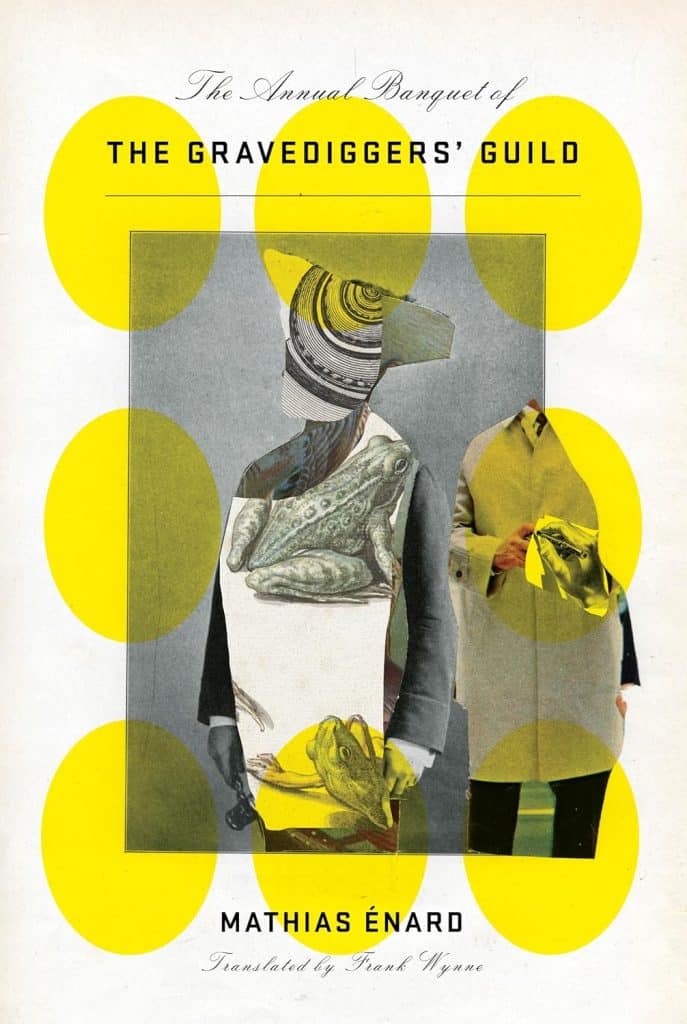
Today, I started reading "The Annual Banquet of the Gravediggers' Guild" by Mathias Énard. The book has been translated into English by Frank Wynne. This novel is full of Mathias Énard's characteristic humor and extensive knowledge. It is a lively book where the boundaries between past and present are constantly blurred, set against a backdrop of excess reminiscent of Rabelais' writing.

Read book review Get this book All books

Share your thoughts and ideas

This site uses Akismet to reduce spam. Learn how your comment data is processed.

The Jan Lilien Education Fund!

The Annual Banquet of the Gravediggers' Guild

Read: January 2024

Get this book

The Annual Banquet of the Gravediggers’ Guild

by Mathias Énard

Today, I started reading “The Annual Banquet of the Gravediggers’ Guild” by Mathias Énard. The book has been translated into English by Frank Wynne. This novel is full of Mathias Énard‘s characteristic humor and extensive knowledge. It is a lively book where the boundaries between past and present are constantly blurred, set against a backdrop of excess reminiscent of Rabelais’ writing.

David Mazon, an anthropology student, moves from Paris to La Pierre-Saint-Christophe, a village in the marshlands of western France, to research his thesis on contemporary agrarian life. He is determined to understand the essence of the local culture and spends his time scurrying around on his moped to interview the residents.

David must be made aware of the extraordinary events in an ordinary location. This place, where wars and revolutions once occurred, is now a dancefloor for Death. When something dies, its soul is recycled by the Wheel of Life and thrown back into the world as a microbe, human, or wild animal – sometimes in the past and sometimes in the future. Once a year, Death and the living agree to a temporary truce, during which gravediggers indulge in a three-day feast filled with food, drink, and conversation.

Mathias Énard’s novel, The Annual Banquet of the Gravediggers’ Guild, is a riotous and exciting comic masterpiece that won the prestigious Prix Goncourt award. The novel is set in the French countryside and is filled with Énard’s characteristic wit and encyclopedic brilliance. Against a backdrop of excess, the story blurs the lines between past and present, creating a Rabelaisian world of chaos and humor.


The Jan Lilien Education Fund sponsors ongoing sustainability and environmental awareness programs. Gifts made this month; I will match dollar-for-dollar. All donations are tax-deductible.

Subscribe

Contact Us

I receive a commission when you buy a book or product using a link on this page. Thank you for supporting Sharing Jan’s Love blog.


×
The Candy House

Read: December 2022

Get this book

The Candy House: A Novel

by Jennifer Egan

The Candy House: A Novel by Jennifer Egan focuses on a new technology that allows you access to every memory you’ve ever had and to share your memories in exchange for access to the memories of others—it has seduced multitudes. According to the NYTimes, “this is minimalist maximalism. As a widow, I live in a world of memories, but I would not want them shared as they are in The Candy House. “It’s as if Egan compressed a big 19th-century novel onto a flash drive.”

Of course, I am not able to access my unconscious memories. Albeit in an amateur way, I write down some of my memories as they remind me of the power of the love that Jan and I shared. For example, the essay when I met Jan rekindles the memory and attempts to tell the story the way it happened, not how some would like it to be remembered.

The Candy House is one of the NYTimes’ top five fiction books of 2022. I have read two of them, The Furrows and Checkout 19. Initially, I was overwhelmed by the multitude of characters and was confused. By the novel’s middle, their interconnectedness helped me understand its real meaning. In the end, Egan delivers a fierce and exhilarating testament to the tenacity and transcendence of human longing for authentic connection, love, family, privacy, and redemption. As a widow, authenticity Is what I need to heal.

The Candy House is the seventieth (70) book I have read this year. 

The Goodreads summary provides an overview.

It’s 2010. Staggeringly successful and brilliant tech entrepreneur Bix Bouton is desperate for a new idea. He’s forty, with four kids, and restless when he stumbles into a conversation with mostly Columbia professors, one of whom is experimenting with downloading or “externalizing” memory. Within a decade, Bix’s new technology, Own Your Unconscious—that allows you access to every memory you’ve ever had and to share every memory in exchange for access to the memories of others—has seduced multitudes. But not everyone.

In spellbinding linked narratives, Egan spins out the consequences of Own Your Unconscious through the lives of multiple characters whose paths intersect over several decades. Egan introduces these characters in an astonishing array of styles—from omniscient to first person plural to a duet of voices, an epistolary chapter, and a chapter of tweets. In the world of Egan’s spectacular imagination, there are “counters” who track and exploit desires and “eluders” who understand the price of taking a bite of the Candy House.

Intellectually dazzling and extraordinarily moving, The Candy House is a bold, brilliant imagining of a world that is moments away. With a focus on social media, gaming, and alternate worlds, you can almost experience moving among dimensions in a role-playing game.​ Egan delivers a fierce and exhilarating testament to the tenacity and transcendence of human longing for real connection, love, family, privacy, and redemption.


The Jan Lilien Education Fund sponsors ongoing sustainability and environmental awareness programs. Gifts made this month; I will match dollar-for-dollar. All donations are tax-deductible.

Subscribe

Contact Us

I receive a commission when you buy a book or product using a link on this page. Thank you for supporting Sharing Jan’s Love blog.


×
Invisible Child

Read: December 2021

Get this book

Invisible Child: Poverty, Survival & Hope in an American City

by Andrea Elliott

Invisible Child: Poverty, Survival & Hope in an American City by Andrea Elliott was a gift from my son Jon. The New York Times selected “Invisible Child” as one of the best books published this year. It is indeed one of the top books on my all-time list.

GoodReads summary provides a good overview,

The riveting, unforgettable story of a girl whose indomitable spirit is tested by homelessness, poverty, and racism in an unequal America—from Pulitzer Prize-winning journalist Andrea Elliott of The New York Times

Invisible Child follows eight dramatic years in the life of Dasani Coates, a child with imagination as soaring as the skyscrapers near her Brooklyn homeless shelter. Born at the turn of a new century, Dasani is named for the bottled water that comes to symbolize Brooklyn’s gentrification and the shared aspirations of a divided city. As Dasani grows up, moving with her tight-knit family from shelter to shelter, this story goes back to trace the passage of Dasani’s ancestors from slavery to the Great Migration north. When Dasani comes of age, New York City’s homeless crisis explodes as the chasm deepens between rich and poor.

In the shadows of this new Gilded Age, Dasani must lead her seven siblings through a thicket of problems: hunger, parental drug addiction, violence, housing instability, segregated schools, and the constant monitoring of the child-protection system. When, at age thirteen, Dasani enrolls at a boarding school in Pennsylvania, her loyalties are tested like never before. As she learns to “code switch” between the culture she left behind and the norms of her new town, Dasani starts to feel like a stranger in both places. Ultimately, she faces an impossible question: What if leaving poverty means abandoning the family you love?

By turns heartbreaking and revelatory, provocative and inspiring, Invisible Child tells an astonishing story about the power of resilience, the importance of family, and the cost of inequality. Based on nearly a decade of reporting, this book vividly illuminates some of the most critical issues in contemporary America through the life of one remarkable girl.

Jan and I were involved and knew that child poverty and homelessness needed repair. In addition, Jan lived on Washington Park across from Ft. Greene Park in 1974-75. We knew the neighborhood where much of the book’s story takes place. 

Before meeting Jan in 1973, I was both a community/tenant organizer and a youth worker. In the latter role, I made weekly hostel trips for eight to ten young boys from East Williamsburg during 1973. The trips were the first the boys had ever been outside of their neighborhood.

Many of them had imaginations like Dasani. They also had her instinct to fight. One of my first tasks was to check for any weapons.

Decades later, when I would see any of them, now adults, they would ask when we were going on another trip. I wish I had met Jan when I made those trips. She would have helped me improve them and document the impact. If I could re-write history, I would have her join me as the second adult on the hostel trips.

After that summer, it was clear my primary skills were as a community/tenant organizer. Over the next few years, my work focused on creating affordable and supportive housing.

Jan and I did meaningful work that made a difference, yet the need for a permanent solution to the crisis remains. The book highlights the crucial role of resilience, the importance of family, and the cost of inequality. As a nation, we cannot undermine those values by breaking up families, impeding resilience, and maintaining racial and economic inequality. 

The current debate in Washington over the Build Back Better legislation needs to focus not on how much we spend but on its impact on children and families

David Brooks, a conservative commentator, has supported these expenditures for what they can do to address this country’s cultural and economic crisis. 

These packages say to the struggling parents and the warehouse workers: I see you. Your work has dignity. You are paving your way. You are at the center of our national vision.

This is how you fortify a compelling moral identity, which is what all of us need if we’re going to be able to look in the mirror with self-respect. This is the cultural transformation that good policy can sometimes achieve. Statecraft is soulcraft.

If you can only read one book this year, this is the one to read. Child poverty, homelessness, and inequality impact all of us. Ending child poverty and homelessness will make us a healthier and more inclusive nation. It is time for a compelling moral call to action!

Subscribe

Contact Us

When you buy a book or product using a link on this page, I receive a commission. Thank you for supporting Sharing Jan’s Love blog.

×
Murder Bimbo

Read: February 2026

Get this book

Murder Bimbo: A Novel

by Rebecca Novack

Murder Bimbo by Rebecca Novack delivers a thrilling, unpredictable tale of a sex worker who morphs into a political assassin, thrust into a high-stakes game of survival. This captivating story weaves together elements of deception, murder, and the complexities of today’s political landscape, offering readers a fresh, gripping perspective that keeps them on the edge of their seats.

The protagonist, a thirty-two-year-old sex worker, is taken by surprise when undercover government agents approach her to assist in a top-secret plot to assassinate a politician known as Meat Neck. However, after the assassination, she realizes the harsh truth: she has been deemed 100% disposable.

Now holed up in an off-the-grid cabin in the woods, she has only two days, her wits, and a laptop to save her own life.

Her best chance is to reach out to the popular feminist investigative podcast, Justice for Bimbos. In a series of hastily typed emails, the newly dubbed Murder Bimbo reveals how she was recruited and trained by a group of covert U.S. agents to eliminate Meat Neck.

Next, she opens a new email addressed to her ex, where the facts present a different narrative.

Structured in three increasingly unhinged acts, each offering a more subversive version of the story than the last, Murder Bimbo is simultaneously a thrilling literary work, a satirical manifesto for vigilantes, or a raucous commentary on the political madness we experience daily. Regardless, it serves as a serious announcement of an electrifying new voice in American literature.


Rebecca Novack grew up in the Rocky Mountains. She has a master’s in theological studies from Harvard Divinity School.


Discover your next favorite book and dive into a world of curated, exciting reads by purchasing through my links. You’ll have access to a diverse selection of books that I’ve personally vetted to ensure quality and enjoyment. Additionally, by supporting these selections, you’ll help me continue to provide you with more personalized recommendations. I earn a small commission from your purchase, which allows me to buy and share even more books with you. Your support truly makes a difference!


×
Death Takes Me

Read: December 2025

Get this book

Death Takes Me: A Novel

by Cristina Rivera Garza

Originally written in Spanish by Cristina Rivera Garza, Death Takes Me is a thrilling masterpiece of literary fiction that turns the traditional crime narrative of gendered violence on its head. As sharp as the cuts on the bodies of the victims, the story unfolds with the dreamlike logic of a surreal experience, transitioning from the police station to a professor’s classroom and through the intricate worlds of Latin American poetry and art. It invites readers to explore the unstable terrains of desire and sexuality.

A city is always a cemetery.

In the narrative, a professor named Cristina Rivera Garza stumbles upon the corpse of a mutilated man in a dark alley and promptly reports it to the police. When shown a crime scene photo, she discovers a stark warning written in tiny print with coral nail polish on the brick wall beside the body: “Beware of me, my love / beware of the silent woman in the desert.”

The professor becomes the primary informant in the case, which is led by a detective who is newly obsessed with poetry and haunted by a list of past failures. But what has the professor truly witnessed? As more bodies of castrated men alongside lines of verse, the detective attempts to decipher the meaning of the poems in hopes of stopping the spreading violence throughout the city.


Cristina Rivera Garza is an acclaimed author known for works such as The Taiga Syndrome and The Iliac Crest. Her memoir, Liliana’s Invincible Summer, won the Pulitzer Prize and was a finalist for the National Book Award. She has received the MacArthur Fellowship and the Sor Juana Inés de la Cruz Prize. Currently, Rivera Garza holds the Hugh Roy and Lillie Cranz Cullen Distinguished Chair and serves as director of the PhD program in Creative Writing in Spanish at the University of Houston.

Sarah Booker is a teacher and a literary translator. Her translations include novels by Mónica Ojeda, Cristina Rivera Garza, and Gabriela Ponce. She is also an associate editor at Southwest Review.

Robin Myers is a poet and translator. Her translations encompass Andrés Neuman’s Bariloche, Claudia Peña Claros’s The Trees, Isabel Zapata’s In Vitro, Eliana Hernández-Pachón’s The Brush, and Cristina Rivera Garza’s The Restless Dead: Necrowriting and Disappropriation.


Discover your next favorite book and dive into a world of curated, exciting reads by purchasing through my links. You’ll have access to a diverse selection of books I’ve personally vetted for quality and enjoyment. Additionally, by supporting these selections, you’ll help me continue to provide you with more personalized recommendations. I earn a small commission from your purchase, which allows me to buy and share even more books with you. Your support truly makes a difference!


×
The Sellout: A Novel

Read: August 2024

Get this book

The Sellout: A Novel

by Paul Beatty

Today, I embarked on the unique narrative journey of The Sellout: A Novel by Paul Beatty. This biting satire, which revolves around a young man’s isolated upbringing and the race trial that takes him to the Supreme Court, is a testament to Paul Beattys comic genius. The Sellout, a part of The New York Times’ 100 Best Books of the Century, is a must-read for those who appreciate a distinct narrative style.

The Sellout is a bold and thought-provoking work that challenges the sacred tenets of the United States Constitution, urban life, and the civil rights movement. It also explores the father-son relationship and the pursuit of racial equality, symbolized by the black Chinese restaurant. This social commentary is a vital aspect of The Sellout, making it a relevant and engaging read for those interested in contemporary issues.

Born in the “agrarian ghetto” of Dickens—on the southern outskirts of Los Angeles—the narrator of The Sellout resigns himself to the fate of lower-middle-class Californians: “I’d die in the same bedroom I’d grown up in, looking up at the cracks in the stucco ceiling that’s been there since ’68 quake.”

Raised by a single father, a controversial sociologist, he spent his childhood as the subject of racially charged psychological studies. Despite these challenges, he believes his father’s pioneering work will result in a memoir that will solve his family’s financial woes. But when his father is killed in a police shoot-out, he realizes there never was a memoir. All that’s left is the bill for a drive-thru funeral.

Fuelled by this deceit and the general disrepair of his hometown, the narrator sets out to right another wrong: Dickens has been removed from the map to save California from further embarrassment. Enlisting the help of the town’s most famous resident—the last surviving Little Rascal, Hominy Jenkins—he initiates the most outrageous action conceivable: reinstating slavery and segregating the local high school, which lands him in the Supreme Court. His determination to fight injustice is a powerful force that drives the narrative forward.

×
Killing Stella

Read: July 2025

Get this book

Killing Stella

by Marlen Haushofer

Yesterday, I read “Killing Stella,” written by Marlen Haushofer and translated by Shaun Whiteside, which is a domestic horror story that culminates in an apocalyptic ending. This novella captures many of the themes present in Haushofer’s acclaimed novel, “The Wall,” presenting them within a claustrophobic, gothic, and striking narrative. It offers a gripping and incisive exploration of a fractured marriage, highlighting the remarkable talent of the author of “The Wall,” now available in English for the first time.

Main description: Left alone for the weekend while her husband and two children visit her in-laws, the narrator of “Killing Stella” recounts the addition of her friend’s daughter, Stella, to their already tense and tumultuous household. As she stares out the window at her garden, she worries about a baby bird in the linden tree, her husband Richard, who flits from one adulterous affair to another, her son’s gloomy demeanor, and her daughter’s obliviousness to everything. Most of all, she worries about Stella, a confused teenager who has met a sudden and disastrous end.


Marlen Haushofer (1920–1970) was an Austrian author known for her short stories, novels, radio plays, and children’s books. Her work has significantly influenced many German-speaking writers, including Nobel Prize winner Elfriede Jelinek, who dedicated one of her plays to Haushofer. One of her most notable works, “The Wall“, was adapted into a film in 2012, directed by Julian Pölsler and starring Martina Gedeck.

Shaun Whiteside is known for his translations of classic works from German, including those by Freud, Musil, and Nietzsche.


When you purchase a book through one of my links, I earn a small commission that helps support my passion for reading. This contribution allows me to buy even more books to share with you, creating an incredible cycle of discovering great reads together! Your support truly makes a difference!

Enjoy a limited-time offer of 20% off your next book purchase at Bookshop.org!


×