New Book: Autobiography of Cotton

Estimated reading time: 0 minutes, 0 seconds
Autobiography of Cotton

Autobiography of Cotton

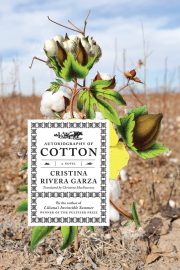
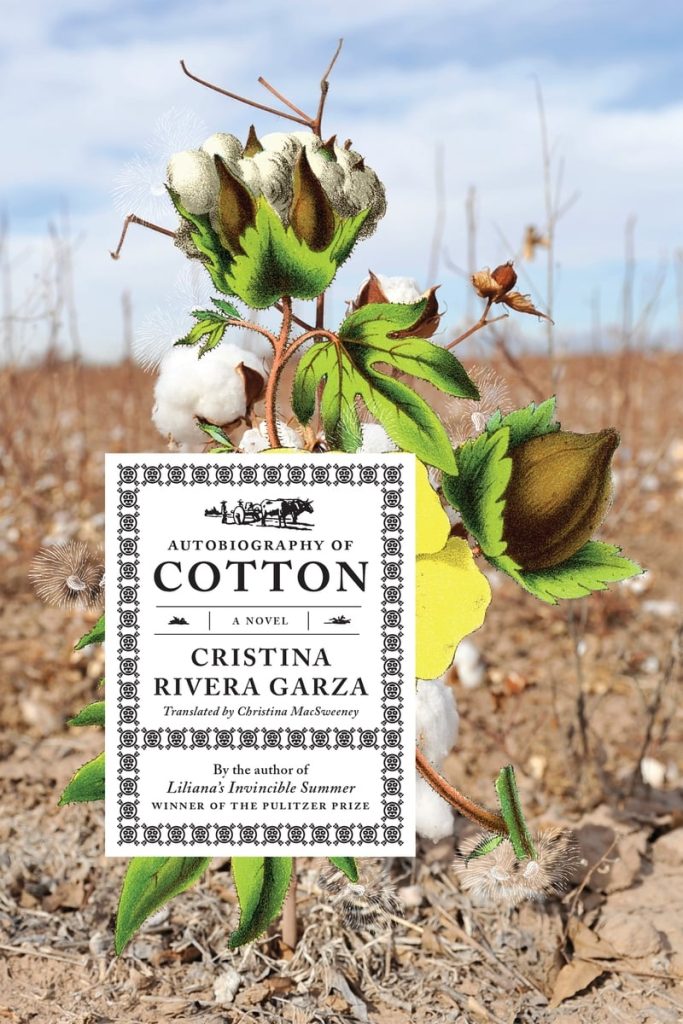
In 1934, a young José Revueltas traveled to Tamaulipas to support the cotton workers' strike in Estación Camarón, which would later serve as the foundation for his landmark novel, Human Mourning. In her groundbreaking novel Autobiography of Cotton, Cristina Rivera Garza recounts her grandparents' journey from mining towns to those same cotton fields. Her narrative intersects with Revueltas's life and offers a vivid and evocative account of the history of cotton cultivation along the Mexico-U.S. border.

Read book review Get this book All books

The Jan Lilien Education Fund!

Autobiography of Cotton

Read: February 2026

Get this book

Autobiography of Cotton

by Cristina Rivera Garza

In 1934, a young José Revueltas traveled to Tamaulipas to support the cotton workers’ strike in Estación Camarón, which would later serve as the foundation for his landmark novel, Human Mourning. In her groundbreaking novel Autobiography of Cotton, Cristina Rivera Garza recounts her grandparents’ journey from mining towns to those same cotton fields. Her narrative intersects with Revueltas’s life and offers a vivid and evocative account of the history of cotton cultivation along the Mexico-U.S. border.

Through archival research and personal narrative, Rivera Garza explores how cotton transformed the borderlands by recounting the story of the cotton workers’ strike. She reveals how cycles of deprivation and environmental destruction continue to affect generations. Rivera Garza skillfully creates a new kind of border novel that illustrates how a fragile landscape drastically changed her grandparents’ lives and the territories they helped to develop. In this intimate fictionalization, Autobiography of Cotton offers a rich social history that encompasses agricultural colonization, labor activism, environmental degradation, and cross-border migration.

I recommend “Autobiography of Cotton,” but readers should be patient as the book shifts back and forth in time. Everything becomes clear as you continue reading.


Cristina Rivera Garza is the Pulitzer Prize–winning author of Liliana’s Invincible Summer. A MacArthur Fellow, she is the Hugh Roy and Lillie Cranz Cullen Distinguished Chair and founder of the University of Houston’s PhD in Creative Writing in Spanish.

Christina MacSweeney is the award-winning literary translator of works by Julián Herbert, Valeria Luiselli, and Elvira Navarro. She received the 2024 Sundial Literary Translation Award for her translation of Verónica Gerber Bicecci‘s The Company.


Discover your next favorite book and dive into a world of curated, exciting reads by purchasing through my links. You’ll have access to a diverse selection of books that I’ve personally vetted to ensure quality and enjoyment. Additionally, by supporting these selections, you’ll help me continue to provide you with more personalized recommendations. I earn a small commission from your purchase, which allows me to buy and share even more books with you. Your support truly makes a difference!


×
Clear: A Novel

Read: April 2024

Get this book

Clear: A Novel

by Carys Davies

Today, I started reading “Clear: A Novel” by Carys Davies. It’s a stunning and exquisite novel written by an award-winning author. The story follows John, a Scottish minister who is sent to a remote island off the coast of Scotland to evict the last remaining inhabitant, Ivar. However, Ivar is unwilling to leave, and John’s wife, Mary, has severe misgivings about the task.

Shortly after arriving on the island, John falls off a cliff and is badly injured. Ivar finds him and takes him home, where he tends to his wounds. John and Ivar understand each other despite the language barrier and the fragile connection that forms.

The story takes place in the 1840s, during the Scottish Clearances, a period of forced evictions that saw many rural communities lose their homes. The novel explores the differences and connections between people, the impact of history on our beliefs, and the resilience of the human spirit.

“Clear” is a moving, unpredictable, sensitive, and spellbinding novel. It is a profound and pleasurable read that will stay with you long after you finish the last page.

×
You Dreamed of Empires: A Novel

Read: December 2024

Get this book

You Dreamed of Empires: A Novel

by Álvaro Enrigue

Today, I began reading “You Dreamed of Empires: A Novel” by Álvaro Enrigue, translated by Natasha Wimmer. This book is from the visionary author of “Sudden Death,” a hallucinatory and revelatory tale of colonial revenge. It has been recognized as one of The New York Times’ 100 Notable Books of 2024 and included in the list of 10 Best Books of 2024. So far, I have read four of the top five fiction books of 2024: “All Fours,” “James,” “Martyr!,” and “Good Material.”

One morning in 1519, conquistador Hernán Cortés entered the city of Tenochtitlan, today’s Mexico City. Later that day, he will meet the emperor Moctezuma in a collision of two worlds, two empires, two languages, and two possible futures.

Cortés is accompanied by his captains, troops, prized horses, and two translators: Friar Aguilar, a taciturn friar, and Malinalli, an enslaved, strategic Nahua princess. After nearly bungling their entrance to the city, the Spaniards are greeted at a ceremonial welcome meal by the steely Aztec princess Atotoxtli, sister and wife of Moctezuma. As they await their meeting with the emperor – who is at a political and spiritual crossroads and relies on hallucinogens to get by – Cortés and his entourage are ensconced in the labyrinthine palace. Soon, one of Cortés’s captains, Jazmín Caldera, overwhelmed by the place’s grandeur, began questioning the ease with which they were welcomed into the city and wondered at the chances of getting out alive, much less conquering the empire. And what if… they don’t?

You Dreamed of Empires brings Tenochtitlan to life at its height and reimagines its destiny. The incomparably original Álvaro Enrigue sets afire the moment of conquest and turns it into a revolution, a restitutive, fantastical counterattack, in a novel so electric and unique that it feels like a dream.


When you purchase a book through one of my links, I earn a small commission that helps support my passion for reading. This contribution allows me to buy even more books to share with you, creating an incredible cycle of discovering great reads together! Your support truly makes a difference!


×
A Gentleman in Moscow

Read: November 2022

Get this book

A Gentleman in Moscow

by Amor Towles

A Gentleman in Moscow by Amor Towles is a transporting novel about a man sentenced by the government to spend the rest of his life inside a luxury hotel. In 1922, a Bolshevik tribunal deemed Count Alexander Rostov an unrepentant aristocrat. His house arrest in the Metropol, a grand hotel across the street from the Kremlin. Rostov, an indomitable man of erudition and wit, has never worked a day and must now live in an attic room while some of the most tumultuous decades in Russian history are unfolding outside the hotel’s doors.

During my grief journey, I have on occasion felt as if I was a prisoner in my apartment, so I found this novel to be one that provided me an alternative to understanding what it would have been like to be under house arrest as Count Rostov was.

A Gentleman in Moscow was a page-turner. The plot captures a unique historical time and how Count Rostov makes the best of a bad situation. I highly recommend this novel.

The Goodreads summary provides an overview.

With his breakout debut novel, Rules of Civility, Amor Towles established himself as a master of absorbing, sophisticated fiction, bringing late 1930s Manhattan to life with a splendid atmosphere and an excellent command of style. As NPR commented, readers and critics were enchanted, “Towles writes with grace and verve about the mores and manners of a society on the cusp of radical change.”

A Gentleman in Moscow immerses us in another elegantly drawn era with the story of Count Alexander Rostov. When, in 1922, he is deemed an unrepentant aristocrat by a Bolshevik tribunal, the count is sentenced to house arrest in the Metropol, a grand hotel across the street from the Kremlin. Rostov, an indomitable man of erudition and wit, has never worked a day. He must now live in an attic room while some of the most tumultuous decades in Russian history are unfolding outside the hotel’s doors. Unexpectedly, his reduced circumstances provide him a doorway into a much larger world of emotional discovery.

Brimming with humor, a glittering cast of characters, and one beautifully rendered scene after another, this singular novel casts a spell as it relates to the count’s endeavor to gain a deeper understanding of what it means to be a man of purpose.


The Jan Lilien Education Fund sponsors ongoing sustainability and environmental awareness programs. Gifts made this month; I will match dollar-for-dollar. All donations are tax-deductible.

Subscribe

Contact Us

I receive a commission when you buy a book or product using a link on this page. Thank you for supporting Sharing Jan’s Love blog.

×
The Sellout: A Novel

Read: August 2024

Get this book

The Sellout: A Novel

by Paul Beatty

Today, I embarked on the unique narrative journey of The Sellout: A Novel by Paul Beatty. This biting satire, which revolves around a young man’s isolated upbringing and the race trial that takes him to the Supreme Court, is a testament to Paul Beattys comic genius. The Sellout, a part of The New York Times’ 100 Best Books of the Century, is a must-read for those who appreciate a distinct narrative style.

The Sellout is a bold and thought-provoking work that challenges the sacred tenets of the United States Constitution, urban life, and the civil rights movement. It also explores the father-son relationship and the pursuit of racial equality, symbolized by the black Chinese restaurant. This social commentary is a vital aspect of The Sellout, making it a relevant and engaging read for those interested in contemporary issues.

Born in the “agrarian ghetto” of Dickens—on the southern outskirts of Los Angeles—the narrator of The Sellout resigns himself to the fate of lower-middle-class Californians: “I’d die in the same bedroom I’d grown up in, looking up at the cracks in the stucco ceiling that’s been there since ’68 quake.”

Raised by a single father, a controversial sociologist, he spent his childhood as the subject of racially charged psychological studies. Despite these challenges, he believes his father’s pioneering work will result in a memoir that will solve his family’s financial woes. But when his father is killed in a police shoot-out, he realizes there never was a memoir. All that’s left is the bill for a drive-thru funeral.

Fuelled by this deceit and the general disrepair of his hometown, the narrator sets out to right another wrong: Dickens has been removed from the map to save California from further embarrassment. Enlisting the help of the town’s most famous resident—the last surviving Little Rascal, Hominy Jenkins—he initiates the most outrageous action conceivable: reinstating slavery and segregating the local high school, which lands him in the Supreme Court. His determination to fight injustice is a powerful force that drives the narrative forward.

×
Stony The Road

Read: October 2019

Get this book

Stony the Road

by Henry Louis Gates Jr

Stony the Road: Reconstruction, White Supremacy, and the Rise of Jim Crow by Henry Louis Gates Jr. is a must-read book, especially with white nationalism on the rise.

I read this book when Jan began her chemotherapy. Although the book’s subject – the retreat from reconstruction – was one I studied in college, at times, I found it hard to focus on the material and my wife’s health at the same time. I stayed on the stony road as it is a subject we need to understand if we are going to correct the past failures.

As The New York Times wrote,

Henry Louis Gates Jr.’s “Stony the Road: Reconstruction, White Supremacy, and the Rise of Jim Crow,” an indispensable guide to the making of our times, addresses 2017’s mystifications. The book sets the Obama era beside Reconstruction and the Trump era beside the white supremacist terrorism of Redemption, the period beginning in 1877 during which Reconstruction’s nascent, biracial democracy was largely dismantled. Gates juxtaposes the optimism of Reconstruction, the despair of Redemption, and the promise of the New Negro movement — the effort by black Americans, starting around the turn of the 20th century, to craft a counternarrative to white supremacy. In doing so, “Stony the Road” presents a bracing alternative to Trump-era white nationalism.

Growing up in the Jim Crow south, I was well aware of white nationalism. This book is an essential read if we are going to make America a multi-racial democracy.

Subscribe

Contact Us

×
The Safekeep: A Novel

Read: July 2025

Get this book

The Safekeep: A Novel

by Yael van der Wouden

A house is a treasured possession, and “The Safekeep,” a debut novel by Yael van der Wouden, presents a gripping story of desire, suspicion, and obsession between two women staying in the same house in the Dutch countryside during the summer of 1961. The novel provides a profound exploration of the legacy of World War II and the darker elements of our shared history.

It is 1961, and the rural Dutch province of Overijssel is quiet. Bomb craters have become lakes, buildings have been repaired or rebuilt, and the war is truly over. Living alone in her late mother’s country home, Isabel knows her life is as it should be—led by routine and discipline. But all is upended when her brother Louis brings his graceless new girlfriend Eva, leaving her at Isabel’s doorstep as a guest, to stay for the season.

Eva is the complete opposite of Isabel: she sleeps late, stomps around the house, and handles things she shouldn’t. In response, Isabel becomes increasingly obsessed and furious, especially as items begin to go missing around the house—a spoon, a knife, a bowl. As her suspicions grow, Isabel’s paranoia eventually leads to infatuation, culminating in a revelation that shatters everything she has ever known. It seems that the war might not truly be over, and neither Eva—nor the house they inhabit—is what they appear to be.

For my house will be called a house of devotion for all,” in Isaiah 56:7, serves as a closing that reminds us that a house not open to all is not a home.


Yael van der Wouden is a writer and a teacher. The Safekeep, her debut novel, was a finalist for the 2024 Booker Prize and has been longlisted for the 2025 Aspen Words Literary Prize. It was also named a New York Times Notable Book of the Year and a best book of the year by The Washington Post, Time, The Economist, Kirkus Reviews, The Times (London), The Independent, BookPage, and others. She lives in Utrecht, Netherlands.


When you purchase a book through one of my links, I earn a small commission that helps support my passion for reading. This contribution allows me to buy even more books to share with you, creating an incredible cycle of discovering great reads together! Your support truly makes a difference!

Enjoy a limited-time offer of 20% off your next book purchase at Bookshop.org!


×