
IMG_1502
Estimated reading time: 0 minutes, 0 seconds
Subscribe to Sharing Jan's Love Newsletter!
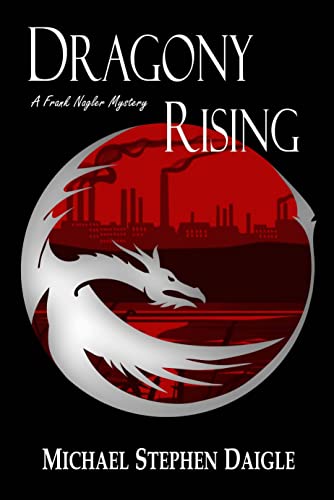
Dragony Rising: A Frank Nagler Novel by Michael Stephen Daigle is the fifth and best Frank Nagler Novel.
Like many of us living in the Garden State, Detective Frank Nagler has seen his hometown of Ironton, NJ, undergo many changes over the past several years. Although I want to believe the level of scandal in Ironton is more fictional than typical. The author describes the scandals within the city’s government, the stench of its corruption embedded deep, rivaling the dank stagnant stench emanating from the old bog just outside town.
From the opening sentence, Dragony Rising was a page-turner. Every time I thought I could put the book down, it beckoned me to keep reading.
I highly recommend this book, especially if you like mysteries with a unique New Jersey focus. My only recommendation would be for the series to be named the Lauren Fox/Frank Nagler novels. Lauren is as much the brains of the operation as Frank.
I have read several Frank Nagler novels-A Game Called Dead, The Swamps of Jersey-and have been waiting for this one to be published.
The author’s summary provides a good overview.
Detective Frank Nagler is recalled from medical leave to lead an investigation into the bombing.
He finds a shadowy organization called The Dragony, whose roots go back to the early days of Ironton’s manufacturing and mining history, a history involving Nagler’s family in strange ways.
He also finds a decades-old conspiracy designed not just to enrich the Dragony leaders but to threaten the existence of Ironton itself.
The Jan Lilien Education Fund sponsors ongoing sustainability and environmental awareness programs. Gifts made this month; I will match dollar-for-dollar. All donations are tax-deductible.
I receive a commission when you buy a book or product using a link on this page. Thank you for supporting Sharing Jan’s Love blog.
by Joanne B. Freeman
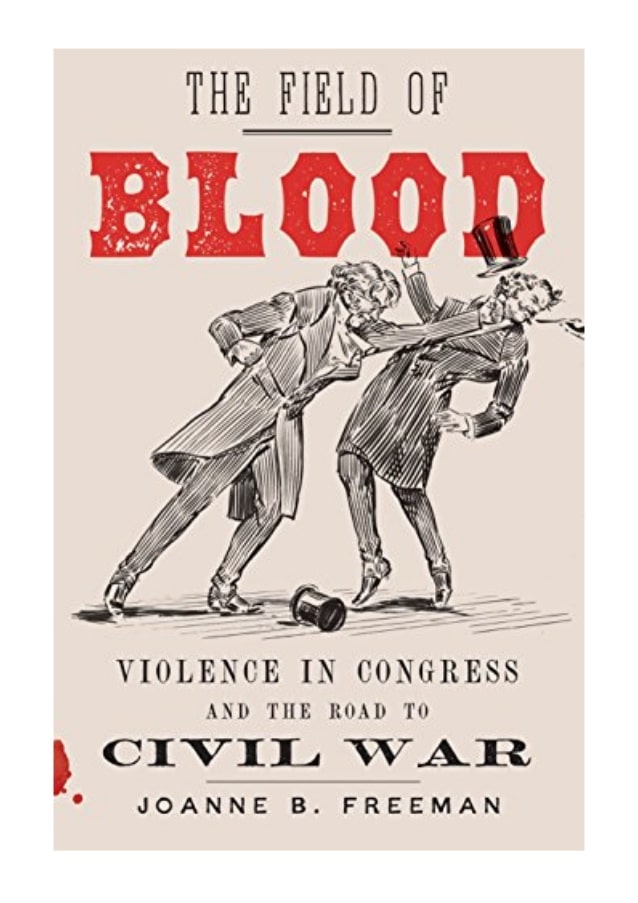
The Field of Blood: Violence in Congress and the Road to Civil War by Joanne B. Freeman, Professor of History and American Studies at Yale University, is a must-read in our hyper-partisan times. The partisanship and divisiveness of the period before the Civil War have many parallels to our time, and the difference is the violence of the Civil War era. Professor Freeman recovers the long-lost story of physical violence on the floor of the U.S. Congress.
She can do this by first source materials from Benjamin Brown French. He was never elected to office but was an acquaintance of twelve consecutive presidents, from Andrew Jackson to Ulysses S. Grant. In addition, he maintained a diary for forty years that highlighted the violence and his and the nation’s political transformation.
During much of this period, he was the Clerk in the House. His diary documents the violence that did not get covered by the press. Legislative sessions included mortal threats, canings, flipped desks, and all-out slugfests. When debate broke down, members of Congress drew pistols and waved Bowie knives. One representative even killed another in a duel. Many were beaten and bullied in an attempt to intimidate them into compliance, particularly on the issue of slavery.
The Field of Blood is one of four books I purchased after my first One Day University class.
by Helen Garner
Today, I began reading Monkey Grip: A Novel by Helen Garner. It’s a book that launched the career of one of Australia’s most celebrated writers. The story follows the infatuations of a young, single mother fascinated by the excesses of Melbourne’s late-70s counterculture. Monkey Grip is a seminal novel about Australia’s turbulent 1970s, including communal households, music, friendships, children, love, drugs, and sex.
Helen Garner is a renowned novelist, short-story writer, and journalist. She’s best known for her frank, unsparing, and intricate portrayals of Australian life, often drawn from the pages of her journals and diaries. A new US edition of her debut novel, which establishes Garner’s masterful and quietly radical literary voice, is now available.
The novel is set in Australia during the late 1970s and tells the story of Nora, a single mother and writer. Nora navigates Melbourne’s bohemian underground with her young daughter, Gracie, in tow. Nora falls in love with Javo, a flighty man trapped in his addiction. As their relationship disintegrates, Nora struggles to wean off a love that feels impossible to live without.
When Monkey Grip was first published in 1977, it caused a sensation. Critics praised Garner for her craft, but many criticized her gritty depictions of the human body, frankness about sex and drugs, the mess of motherhood, and her unabashed use of her own life as inspiration. Today, such criticism feels old-fashioned and glaringly gendered, and Monkey Grip is considered a modern masterpiece.
by Etgar Keret
“Autocorrect” by Etgar Keret, a prominent figure in Israeli literature and film, is a darkly humorous collection of stories that delves into themes of identity, reality, and meaning. These narratives resonate with our current times, characterized by uncertainty and fragility, marked by misunderstandings and miscommunications, as we seek reasons and the strength to foster hope.
Etgar Keret‘s stories reveal the fault lines and uncomfortable truths in our society, all delivered in a style that is uniquely his own. He is the world’s most renowned living Israeli writer, known for his lean and accessible short stories that often blend whimsy, surrealism, and dark humor. Keret’s work explores the most minor and seemingly mundane aspects of life in profound and unusual ways.
The characters in his fiction face relatable challenges in work and relationships. They inhabit a world filled with rapidly advancing technology, yet the base nature of human passions and brutality repeatedly undermines this world. For instance, one character’s partner is a reality show contestant from a parallel dimension. At the same time, another discovers that the asteroid he paid to have named after his wife is on a collision course with Earth. In another story, an elderly widow persuades a popular AI program to commit suicide.
Etgar Keret, born in Ramat Gan in 1967, is a prominent figure in Israeli literature and film. Translated into more than forty languages, his writing has appeared in well-known publications such as The New York Times, Le Monde, and The New Yorker. He has received several prestigious awards, including the Caméra d’Or at the Cannes Film Festival in 2007, the Charles Bronfman Prize in 2016, and the esteemed Sapir Prize in 2018.
More than a hundred captivating short films and several remarkable feature films have brought his stories to life on the big screen. Keret teaches creative writing at Ben-Gurion University of the Negev. Since 2021, he has also been publishing a weekly newsletter titled “Alphabet Soup” on Substack.
When you purchase a book through one of my links, I earn a small commission that helps support my passion for reading. This contribution allows me to buy even more books to share with you, creating an incredible cycle of discovering great reads together! Your support truly makes a difference!
Enjoy a limited-time offer of 20% off your next book purchase at Bookshop.org!
by Ethan Rutherford
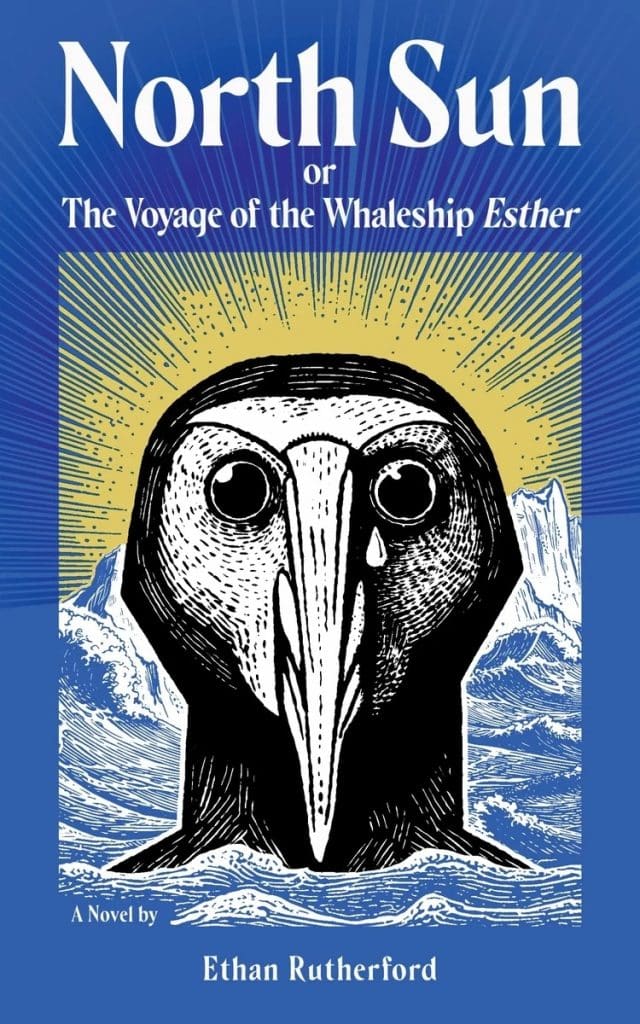
“North Sun: Or, the Voyage of the Whaleship Esther” by Ethan Rutherford is a finalist for the fiction category of the 2025 National Book Award. With one foot firmly planted in the traditional sea-voyage narrative, and another in a blazing mythos of its own, this debut novel looks unsparingly at the cost of environmental exploitation and predation, and in doing so feverishly sings not only of the past, but to the present and future as well.
Setting out from New Bedford in 1878, the crew of the Esther is confident the sea will be theirs: in addition to cruising the Pacific for whales, they intend to hunt the teeming northern grounds before the ice closes. But as they sail to their final destination in the Chukchi Sea, where their captain Arnold Lovejoy has an urgent directive of his own to attend to, their encounters with the natural world become more brutal, harrowing, ghostly, and strange.
Ethan Rutherford‘s fiction has appeared in BOMB, Tin House, Electric Literature, Ploughshares, One Story, American Short Fiction, Conjunctions, and The Best American Short Stories. He is the author of two story collections–Farthest South (Deep Vellum, 2020) and The Peripatetic Coffin and Other Stories (Ecco, 2013)–and for these works has been named a finalist for the Los Angeles Times Art Seidenbaum Award for First Fiction, a finalist for the John Leonard Prize and CLMP’s Firecracker Award, received honorable mention for the PEN/Hemingway Award, was a Barnes & Noble Discover Great New Writers selection, and was the winner of a Minnesota Book Award.
Born in Seattle, Washington, he received his MFA in Creative Writing from the University of Minnesota and now teaches Creative Writing at Trinity College. He lives in Hartford, Connecticut, with his wife and two children.
Discover your next favorite book and dive into a world of curated, exciting reads by purchasing through my links. You’ll have access to a diverse selection of books that I’ve personally vetted to ensure quality and enjoyment. Additionally, by supporting these selections, you’ll help me continue to provide you with more personalized recommendations. I earn a small commission from your purchase, which allows me to buy and share even more books with you. Your support truly makes a difference!
by Walt Hunter
The Singing Word: 168 Years of Atlantic Poetry, edited by Walt Hunter, celebrates the people, land, and spirit of America. This remarkable collection showcases a wide range of contemporary and historical poetry from the 168-year archive of The Atlantic magazine. Since its first issue in 1857, the poetry published in The Atlantic has drawn attention to the nation’s ongoing journey of self-discovery.
The magazine’s verse has featured odes to American leaders and landscapes, laments for the dead, and calls for change, appealing to the enduring ideals of Atlantic readers.
This one-of-a-kind collection selects poems of rousing optimism, clear-eyed realism, and moving lyricism—poems infused with the language of America’s songs, myths, and history, from the Civil War up through the present in three rich parts: National Anthems, Natural Lines, and Personal Mythologies.
Curated by The Atlantic’s Poetry Editor, this anthology features both world-famous poets—from Longfellow to Limón, including Robert Frost, W. S. Merwin, Sylvia Plath, and Adrienne Rich—as well as poets whose work has never before been published outside of the magazine.
Offering readers an essential understanding of American canon and the evolving nation, its poets have yearned to capture—the poetry of The Atlantic is the poetry of America.
Walt Hunter is a professor of twentieth- and twenty-first-century literature and chair of the English department at Case Western Reserve University. He is also the fiction and poetry editor for The Atlantic.
Discover your next favorite book and dive into a world of curated, exciting reads by purchasing through my links. You’ll have access to a diverse selection of books that I’ve personally vetted to ensure quality and enjoyment. Additionally, by supporting these selections, you’ll help me continue to provide you with more personalized recommendations. I earn a small commission from your purchase, which allows me to buy and share even more books with you. Your support truly makes a difference!