
A Small Sacrifice for an Enormous Happiness

Estimated reading time: 2 minutes, 3 seconds

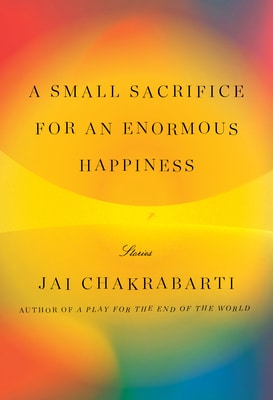
I recently discovered an excellent short story collection called A Small Sacrifice for an Enormous Happiness: Stories by Jai Chakrabarti. This author won the National Jewish Book Award for debut fiction with his novel A Play for the End of the World, and it is clear that his talent extends to the short story form as well.

The stories in this collection follow men and women as they navigate transformations and familial bonds across countries and cultures. Each story is unique and captivating, but the one that struck me was the title story about a closeted gay man in 1980s Kolkata who seeks to have a child with his lover’s wife. Chakrabarti’s skill as a storyteller is on full display in this story and throughout the collection.

I highly recommend A Small Sacrifice for an Enormous Happiness: Stories if you want a book exploring love and family’s complexities in uncertain times. Each story is a masterful exploration of what it means to cultivate a family across borders, religions, and races. I look forward to reading more by Jai Chakrabarti in the future.

The Goodreads summary provides an overview,

In the fourteen masterful stories of this collection, Jai Chakrabarti crosses continents and cultures to explore what it means to cultivate a family across borders, religions, and races today.

In the title story, a closeted gay man in 1980s Kolkata seeks to have a child with his lover’s wife. An Indian widow, engaged to a Jewish man, struggles to balance her cultural identity with the rituals and traditions of her newfound family. An American musician travels to see his guru for the final time—and makes a promise he cannot keep. A young woman from an Indian village arrives in Brooklyn to care for the toddler of a biracial couple. And a mystical agent is sent by a mother to solve her son’s domestic problems.

Throughout, the characters’ most vulnerable desires shape life-altering decisions as they seek to balance their needs against those of the people they hold closest.


The Jan Lilien Education Fund sponsors ongoing sustainability and environmental awareness programs. Gifts made this month; I will match dollar-for-dollar. All donations are tax-deductible.

Subscribe

Contact Us

I receive a commission when you buy a book or product using a link on this page. Thank you for supporting Sharing Jan’s Love blog.


The Jan Lilien Education Fund!

Self-Portrait with Ghost: Short Stories

Read: December 2022

Get this book

Self-Portrait with Ghost: Short Stories

by Meng Jin

Self-Portrait with Ghost: Short Stories by Meng Jin was written during the turbulent years of the Trump administration and the first year of the pandemic, these stories explore intimacy and isolation, coming of age, and coming to terms with the repercussions of past mistakes, fraying relationships, and surprising moments of connection. I highly recommend Self-Portrait with Ghost: Short Stories!

Each story speaks so clearly to the loneliness epidemic that confronts our world. I would read one short story and promise to stop and wait until another day to read the next one. Instead

One phrase that will always remain with me is: “The hallucinatory quality of grief.” As a widow, the phrase struck a chord that will forever resonate in my soul.

This is the seventy-third book I have read this year.

The Goodreads summary provides an overview,

Meng Jin’s critically acclaimed debut novel, Little Gods, was praised as “spectacular and emotionally polyphonic (Omar El-Akkad, BookPage), “powerful” (Washington Post), and “meticulously observed, daringly imagined” (Claire Messud). Jin turns her considerable talents into short fiction in ten thematically linked stories.

Moving between San Francisco and China, and from unsparing realism to genre-bending delight, Self-Portrait with Ghost considers what it means to live in an age of heightened self-consciousness, seemingly unlimited access to knowledge, and little actual power.

Page-turning, thought-provoking, and wholly unique, Self-Portrait with Ghost further establishes Meng Jin as a writer who “reminds us that possible explanations in our universe are as varied as the beings who populate it” (Paris Review).


The Jan Lilien Education Fund sponsors ongoing sustainability and environmental awareness programs. Gifts made this month; I will match dollar-for-dollar. All donations are tax-deductible.

Subscribe

Contact Us

I receive a commission when you buy a book or product using a link on this page. Thank you for supporting Sharing Jan’s Love blog.


×
Invisible Child

Read: December 2021

Get this book

Invisible Child: Poverty, Survival & Hope in an American City

by Andrea Elliott

Invisible Child: Poverty, Survival & Hope in an American City by Andrea Elliott was a gift from my son Jon. The New York Times selected “Invisible Child” as one of the best books published this year. It is indeed one of the top books on my all-time list.

GoodReads summary provides a good overview,

The riveting, unforgettable story of a girl whose indomitable spirit is tested by homelessness, poverty, and racism in an unequal America—from Pulitzer Prize-winning journalist Andrea Elliott of The New York Times

Invisible Child follows eight dramatic years in the life of Dasani Coates, a child with imagination as soaring as the skyscrapers near her Brooklyn homeless shelter. Born at the turn of a new century, Dasani is named for the bottled water that comes to symbolize Brooklyn’s gentrification and the shared aspirations of a divided city. As Dasani grows up, moving with her tight-knit family from shelter to shelter, this story goes back to trace the passage of Dasani’s ancestors from slavery to the Great Migration north. When Dasani comes of age, New York City’s homeless crisis explodes as the chasm deepens between rich and poor.

In the shadows of this new Gilded Age, Dasani must lead her seven siblings through a thicket of problems: hunger, parental drug addiction, violence, housing instability, segregated schools, and the constant monitoring of the child-protection system. When, at age thirteen, Dasani enrolls at a boarding school in Pennsylvania, her loyalties are tested like never before. As she learns to “code switch” between the culture she left behind and the norms of her new town, Dasani starts to feel like a stranger in both places. Ultimately, she faces an impossible question: What if leaving poverty means abandoning the family you love?

By turns heartbreaking and revelatory, provocative and inspiring, Invisible Child tells an astonishing story about the power of resilience, the importance of family, and the cost of inequality. Based on nearly a decade of reporting, this book vividly illuminates some of the most critical issues in contemporary America through the life of one remarkable girl.

Jan and I were involved and knew that child poverty and homelessness needed repair. In addition, Jan lived on Washington Park across from Ft. Greene Park in 1974-75. We knew the neighborhood where much of the book’s story takes place. 

Before meeting Jan in 1973, I was both a community/tenant organizer and a youth worker. In the latter role, I made weekly hostel trips for eight to ten young boys from East Williamsburg during 1973. The trips were the first the boys had ever been outside of their neighborhood.

Many of them had imaginations like Dasani. They also had her instinct to fight. One of my first tasks was to check for any weapons.

Decades later, when I would see any of them, now adults, they would ask when we were going on another trip. I wish I had met Jan when I made those trips. She would have helped me improve them and document the impact. If I could re-write history, I would have her join me as the second adult on the hostel trips.

After that summer, it was clear my primary skills were as a community/tenant organizer. Over the next few years, my work focused on creating affordable and supportive housing.

Jan and I did meaningful work that made a difference, yet the need for a permanent solution to the crisis remains. The book highlights the crucial role of resilience, the importance of family, and the cost of inequality. As a nation, we cannot undermine those values by breaking up families, impeding resilience, and maintaining racial and economic inequality. 

The current debate in Washington over the Build Back Better legislation needs to focus not on how much we spend but on its impact on children and families

David Brooks, a conservative commentator, has supported these expenditures for what they can do to address this country’s cultural and economic crisis. 

These packages say to the struggling parents and the warehouse workers: I see you. Your work has dignity. You are paving your way. You are at the center of our national vision.

This is how you fortify a compelling moral identity, which is what all of us need if we’re going to be able to look in the mirror with self-respect. This is the cultural transformation that good policy can sometimes achieve. Statecraft is soulcraft.

If you can only read one book this year, this is the one to read. Child poverty, homelessness, and inequality impact all of us. Ending child poverty and homelessness will make us a healthier and more inclusive nation. It is time for a compelling moral call to action!

Subscribe

Contact Us

When you buy a book or product using a link on this page, I receive a commission. Thank you for supporting Sharing Jan’s Love blog.

×
Western Lane: A Novel

Read: March 2023

Get this book

Western Lane: A Novel

by Chetna Maroo

Western Lane: A Novel by Chetna Maroo is a taut, enthralling first novel about grief, sisterhood, and a young athlete’s struggle to transcend herself. Western Lane is about three sisters who have lost their mother. Their father is encouraged to provide structure in raising his daughters. Gopi, the narrator, is a squash player, and her father imposes a brutal training regimen. I highly recommend this novel!

The following passage explains the importance of squash to Gopi and how she views the world.

In the court, your mind is not only on the shot you’re about to play and the shot with which your opponent might reply, but on the shots that will follow two, three, four moves ahead. You’re watching your opponent’s position and the game he or she is playing, making calculations. This is how you choose which way to go. Though your mind is following several paths at once, it’s not a splitting but expansion forwards and backward in time, and it happens so quickly that it feels like instinct. Sometimes, you don’t even know you are thinking.

In the first few pages, I wondered what I would have done if I had been a single parent when my sons were young. I do not believe I would have imposed on my sons what Gopi’s father did to her. However, I have found reading and art to be powerful tools to help me cope with grief. I have focused on rituals, structure, and purpose.

The Goodreads summary provides an overview,

Eleven-year-old Gopi has been playing squash since she was old enough to hold a racket. When her mother dies, her father enlists her in a quietly brutal training regimen, and the game becomes her world. Slowly, she grows apart from her sisters. Her life is reduced to the sport, guided by its rhythms: the serve, the volley, the drive, the shot, and its echo.

But on the court, she is not alone. She is with her pa. She is with Ged, a thirteen-year-old boy with formidable talent. She is with the players who have come before her. She is in awe.

An indelible coming-of-age story, Chetna Maroo’s first novel captures the ordinary and annihilates it with beauty. Western Lane is a valentine to innocence, to the closeness of sisterhood, to the strange ways we know ourselves and each other.


The Jan Lilien Education Fund sponsors ongoing sustainability and environmental awareness programs. Gifts made this month; I will match dollar-for-dollar. All donations are tax-deductible.

Subscribe

Contact Us

I receive a commission when you buy a book or product using a link on this page. Thank you for supporting Sharing Jan’s Love blog.


×
Flashlight

Read: August 2025

Get this book

Flashlight: A Novel

by Susan Choi

A monumental new novel by National Book Award winner Susan Choi, Flashlight spans decades and continents in a captivating and emotional exploration of family, loss, memory, and the ways we are influenced by what remains hidden. Longlisted for the 2025 Booker Prize, the novel follows the journey of a father’s disappearance over time, across nations, and within the realm of memory. This work comes from the author of Trust Exercise.

On a summer night, Louisa and her father take a walk along the breakwater. Her father is carrying a flashlight, but he cannot swim. Later, Louisa is found on the beach, soaked to the skin and barely alive. Her father is missing. She is only ten years old.

Louisa is the only child of parents who have distanced themselves from their pasts. Her father, Serk, is Korean but was born and raised in Japan. He lost touch with his family after they embraced the promises of postwar Pyongyang and relocated to North Korea. Her American mother, Anne, is estranged from her Midwestern family due to a reckless adventure in her youth. Then there’s Tobias, Anne’s illegitimate son, whose unexpected return will have profound consequences.

For now, it is just Anne and Louisa—Louisa and Anne—adrift and facing the challenges of everyday life in the aftermath of their immense loss. Bound together yet estranged, they struggle to cope with their shared grief and attempt to move forward. However, they cannot escape the haunting memories of that fateful night. What happened to Louisa’s father?

With shifting perspectives across time and character, and repeatedly revisiting that night by the sea, Flashlight explores the shockwaves of one family’s tragedy while also engaging with the invisible currents of history.


Susan Choi is the author of Trust Exercise, which won the National Book Award for fiction. She has also written the novels The Foreign Student, American Woman, A Person of Interest, and My Education.

Choi has received several prestigious awards, including the Asian American Literary Award for fiction, the PEN/W. G. Sebald Award, a Lambda Literary Award, and the Sunday Times Audible Short Story Award. Additionally, she has been awarded fellowships from the National Endowment for the Arts and the Guggenheim Foundation.

Currently, she teaches in the Writing Seminars at Johns Hopkins University and resides in Brooklyn, New York.


When you purchase a book through one of my links, I earn a small commission that helps support my passion for reading. This contribution allows me to buy even more books to share with you, creating an incredible cycle of discovering great reads together! Your support truly makes a difference!

Enjoy a limited-time offer of 20% off your next book purchase at Bookshop.org!


×
The Searcher: A Novel

Read: March 2024

Get this book

The Searcher: A Novel

by Tana French

Today, I started reading Tana French‘s The Searcher: A Novel. Last week, I read The Hunter by the same author. I should have read The Searcher first, as it is the prequel to The Hunter, but reading in reverse order helped my enjoyment. Despite knowing some of the suspenseful twists and turns the story would take, I found it a page-turner.

The story follows Cal Hooper, a retired Chicago police officer who seeks a fresh start in a tranquil Irish village. However, when a local boy approaches him to investigate his missing brother, Cal discovers that the town has its share of dark secrets. The book raises thought-provoking questions about distinguishing right from wrong in a complicated world and what we risk when making that decision.

Tana French is a highly acclaimed crime novelist who skillfully creates a captivating and suspenseful atmosphere throughout the book.

×
The Rest Is Memory: A Novel

Read: January 2025

Get this book

The Rest Is Memory: A Novel

by Lily Tuck

Today, I dove into “The Rest Is Memory: A Novel” by Lily Tuck, and it’s already leaving a powerful impression. This poignant tale follows a young Catholic girl’s harrowing journey to Auschwitz, woven in a captivating Rashomon-style narrative showcasing Tuck’s brilliance as a storyteller. Esquire has rightly placed it on their list of Best Books for Fall 2024, and I can see why.

In Tuck‘s skilled hands, “The Rest Is Memory” transforms into an unforgettable piece of historical reclamation, breathing life into an innocent soul who has long been remembered only through a haunting triptych of photographs. It’s a journey that promises to linger in my thoughts long after I’ve turned the last page.

In this mesmerizing novel by Lily Tuck, we first glimpse fourteen-year-old Czeslawa riding on the back of a boy’s motorcycle. Tuck imagines Czeslawa’s upbringing in a small Polish village before her world imploded in late 1942. Stripped of her modest belongings, she arrives at Auschwitz shorn and bearing the tattoo number 26947. Shortly after, she is photographed. Three months later, she is dead.

How did this happen to an ordinary Polish citizen? This is the question Tuck grapples with in this haunting narrative, which frames Czeslawa’s story within the tragic context of the six million Poles who perished during the German occupation. A decade before writing The Rest Is Memory“, Tuck read an obituary of the photographer Wilhelm Brasse, who took over 40,000 pictures of Auschwitz prisoners—including three of Czeslawa Kwoka, a Catholic girl from rural southeastern Poland. Tuck cut out these photos and kept them, determined to learn more about Czeslawa. However, she could only gather the barest facts: the village she came from, the transport she was on, that she was accompanied by her mother and neighbors, her tattoo number, and the date of her death. Tuck crafts a remarkable kaleidoscope of imagination from this scant evidence, something only our greatest novelists can achieve.

Susanna Moore described the novel as “Beautifully written, all the while instilling a sense of horror.” Tuck’s language swirls around the reader, yet no word is out of place. The subtly rotating images tumble forth, accelerating as we learn about Czeslawa’s tragic time in Auschwitz, as well as the lives of real individuals, including the brutal Commandant Rudolf Höss, his unconscionable wife Hedwig, psychiatrist and child rescuer Janusz Korczak, and the sharp Polish short story writer Tadeusz Borowski. Although we know Czeslawa’s fate, we must keep turning the pages, thoroughly captivated by Tuck’s nearly otherworldly prose.


When you purchase a book through one of my links, I earn a small commission that helps support my passion for reading. This contribution allows me to buy even more books to share with you, creating an incredible cycle of discovering great reads together! Your support truly makes a difference!


×