Managing My Grief With a Day in the Park!

Managing My Grief With a Day in the Park!

Estimated reading time: 0 minutes, 48 seconds
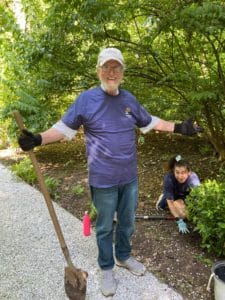
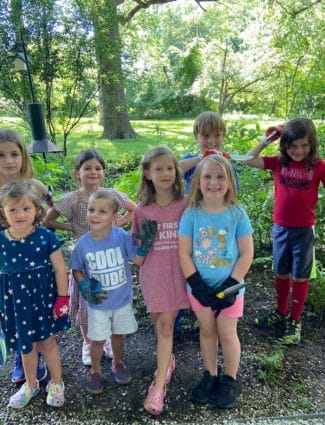
Managing My Grief With a Day in the Park!On Thursday, June 9, 2022, I volunteered with Hanson Park Conservancy to clean up the park.

It was a lovely day to work with friends and neighbors.

Sometimes, spending a day volunteering with friends can help me manage my grief. Whatever I do, I will never replace Jan or stop grieving.

But a day in the park can help.

A few people who were unaware of the plans for Jan’s garden asked if there was a plan for the triangle—reviewing the design for The Jan Lilien Memorial Garden this summer was a moment of happiness.

Am additional fifteen photos are on Facebook.

Please consider making a tax-deductible donation to support The Jan Lilien Education Fund.


Subscribe

Contact Us

When you buy a book or product using a link on this page, I receive a commission. Thank you for supporting Sharing Jan’s Love blog.

1 comment add your comment

Share your thoughts and ideas

This site uses Akismet to reduce spam. Learn how your comment data is processed.

The Jan Lilien Education Fund!

Managing My Grief With a Day in the Park!
×
Hurricane Season

Read: September 2024

Get this book

Hurricane Season

by Fernanda Melchor

Hurricane Season‘ by Fernanda Melchor, translated by Sophie Hughes, is a literary gem acknowledged by the New York Times as one of the 100 Best Books of the 21st Century. The story opens with the discovery of a dead witch in a village, leading to an investigation into her murder. As the novel unfolds, it offers a unique perspective on the lives of the villagers, each narrating the story from their point of view.

This unique portrayal of the characters, each with flaws and virtues, uncovers new details and acts of depravity. Despite the characters being seen as irredeemable, Melchor extracts some shred of humanity from them, creating a lasting portrait of a doomed Mexican village. This deep connection to Mexican culture is a significant aspect of the novel that will surely resonate with readers interested in this topic.

Hurricane Season” draws significant literary inspiration from Roberto Bolaño‘s “2666” and Faulkner‘s novels. Like these works, it is set in a world filled with mythology and actual violence that seeps into the surroundings, creating a connection that makes it more terrifying the deeper you explore it.

×
Losing Earth: A Recent History

Read: October 2019

Get this book

Losing Earth: A Recent History

by Nathaniel Rich

Losing Earth: A Recent History by Nathaniel Rich reminds us how close we were to halting the climate emergency, and our failure has resulted in our passing the tilting point. The book “reveals, in previously unreported detail, the birth of climate denialism and the genesis of the fossil-fuel industry’s coordinated effort to thwart climate policy through misinformation propaganda and political influence.”

By 1979, we knew nearly everything we understand today about climate change – including how to stop it. Over the next decade, a handful of scientists, politicians, and strategists, led by two unlikely heroes, risked their careers in a desperate, escalating campaign to convince the world to act before it was too late. Losing Earth is their story and ours.

The New York Times Magazine devoted an entire issue to Nathaniel Rich’s groundbreaking chronicle of that decade, which became an instant journalistic phenomenon – the subject of news coverage, editorials, and conversations all over the world. In its emphasis on the lives of the people who grappled with the significant existential threat of our age, it made vivid the moral dimensions of our shared plight.

Losing Earth tells the human story of climate change in even richer, more intimate terms. It reveals, in previously unreported detail, the birth of climate denialism and the genesis of the fossil-fuel industry’s coordinated effort to thwart climate policy through misinformation propaganda and political influence. The audiobook carries the story into the present day, wrestling with the long shadow of our past failures and asking crucial questions about how we make sense of our past, our future, and ourselves.

Like John Hersey’s Hiroshima and Jonathan Schell’s The Fate of the Earth, Losing Earth is the rarest of achievements: a riveting work of dramatic history that articulates a moral framework for understanding how we got here and how we must go forward.

Losing Earth is a must-read book!

Subscribe

Contact Us

×
How Democracies Die

Read: January 2021

Get this book

How Democracies Die: What History Reveals About Our Future

by Steven Levitsky and Daniel Ziblatt

How Democracies Die: What History Reveals About Our Future by Steven Levitsky and Daniel Ziblatt was on my reading list for almost a year. In late December of last year, I started reading it and was in the final chapter on January 6, 2021. Like many of us, I never in my life expected to see a day like that in our country.

This type of event is one the authors talk about in their book.

According to the overview in GoodReads,

Donald Trump’s presidency has raised a question that many of us never thought we’d be asking: Is our democracy in danger? Harvard professors Steven Levitsky and Daniel Ziblatt have spent more than twenty years studying the breakdown of democracies in Europe and Latin America, and they believe the answer is yes. Democracy no longer ends with a bang–in a revolution or military coup–but with a whimper: the slow, steady weakening of critical institutions, such as the judiciary and the press, and the gradual erosion of long-standing political norms. The good news is that there are several exit ramps on the road to authoritarianism. The bad news is that, by electing Trump, we have already passed the first one.

Drawing on decades of research and a wide range of historical and global examples, from 1930s Europe to contemporary Hungary, Turkey, and Venezuela, to the American South during Jim Crow, Levitsky and Ziblatt show how democracies die–and how ours can be saved.

Our democracy is too valuable for us to have it die. We all need to work to preserve and strengthen it. How Democracies Die is a book that everyone needs to read!

Subscribe

Contact Us

×
Sarah's Key

Read: January 2022

Get this book

Sarah’s Key

by Tatiana de Rosnay

Sarah’s Key by Tatiana de Rosnay is the untold story of the roundup of the Jews in Paris in July 1942. The novel focuses on how the French were complicit in rounding up thousands of Jews in 1942. It is also a reminder that we can never allow another genocide. I finished this book the day before Holocaust Remembrance Day, January 27, the date on which the Auschwitz-Birkenau concentration and death camp complex was liberated in 1945.

Ten-year-old Sarah is brutally arrested with her family in the Vel’ d’Hiv’ roundup, the most notorious act of French collaboration with the Nazis. But before the police come to take them, Sarah locks her younger brother, Michel, in their favorite hiding place, a cupboard in the family’s apartment. She keeps the key, thinking she will be back within a few hours.

Paris, May 2002: On Vel’ d’Hiv’s sixtieth anniversary, Julia Jarmond, an American journalist, is asked by her Paris-based American magazine to write an article about this black day in France’s past. Julia has lived in Paris for nearly twenty-five years and married a Frenchman, and she is shocked both by her ignorance about the event and the silence that still surrounds it.

The twin narratives of Sarah and Julia hold the first two-thirds of the book together and make it a page-turner. Sarah’s memory reminds us during the final third of the book and ensures that the complete story of the Vel’ d’Hiv’ roundup and its lasting impact are told.

As Goodreads describes the novel,

In the course of her investigation, she stumbles onto a trail of long-hidden family secrets that connects her to Sarah. Julia finds herself compelled to retrace the girl’s ordeal, from the terrible days spent shut in at the Vel’ d’Hiv’ to the camps and beyond. As she probes into Sarah’s past, she begins to question her own place in France and to reevaluate her marriage and her life.

Writing about the fate of her country with a pitiless clarity, Tatiana de Rosnay offers us a brilliantly subtle, compelling portrait of France under occupation and reveals the taboos and denial surrounding this painful episode in French history.

I highly recommend the book.

Subscribe

Contact Us

When you buy a book or product using a link on this page, I receive a commission. Thank you for supporting Sharing Jan’s Love blog.
×
The Morningside: A Novel

Read: March 2024

Get this book

The Morningside: A Novel

by Téa Obreht

Today, I started reading The Morningside: A Novel by Téa Obreht. The book tells the story of Silvia and her mother, who have been expelled from their home and have settled in a luxury tower called Island City, where Silvia’s aunt Ena is the superintendent. The Morningside is a place of magical possibilities, where Ena shares folktales with Silvia about her demolished homeland, a place of natural beauty and communal spirit. This starkly contrasts Silvia’s current reality, where she feels unmoored and disconnected from her past.

Silvia is fascinated by Bezi Duras, an enigmatic woman who lives in the penthouse and is shrouded in mystery. Bezi has her elevator entrance and only leaves the building at night to walk her three massive hounds, returning in the early morning. Silvia becomes obsessed with unraveling the truth about Bezi’s life and haunted past, even if it comes at a significant cost to her.

The Morningside is an inventive and moving novel that explores the power of storytelling and how we use it to make sense of our lives and the world around us.

×
The Last White Man

Read: August 2022

Get this book

The Last White Man: A Novel

by Mohsin Hamid

The Last White Man by Mohsin Hamid is a story of love, loss, and rediscovery in a time of unsettling change. One morning, Anders, the novel’s protagonist,  wakes to find that his skin has turned dark, his reflection a stranger to him. At first, he tells only Oona, an old friend, newly a lover. Soon, reports of similar occurrences surface across the land.

In Mohsin Hamid’s “lyrical and urgent” prose (O Magazine), The Last White Man powerfully uplifts our capacity for empathy and the transcendence over bigotry, fear, and anger it can achieve.

I highly recommend this book. It was a page-turner that kept me thinking about love, loss, and rediscovery. All three are subjects close to my heart since Jan’s death.

I decided to read the book after hearing an interview with the author on All of It on WNYC.

The Goodreads summary provides a good overview,

One morning, Anders wakes to find that his skin has turned dark, his reflection a stranger to him. At first he tells only Oona, an old friend, newly a lover. Soon, reports of similar occurrences surface across the land. Some see in the transformations the long-dreaded overturning of an established order, to be resisted to a bitter end. In many, like Anders’s father and Oona’s mother, a sense of profound loss wars with profound love. As the bond between Anders and Oona deepens, change takes on a different shading: a chance to see one another, face to face, anew.

Hamid’s The Last White Man invites us to envision a future – our future – that dares to reimagine who we think we are, and how we might yet be together.


The Jan Lilien Education Fund sponsors ongoing sustainability and environmental awareness programs. Gifts made this month; I will match dollar-for-dollar. All donations are tax-deductible.

Subscribe

Contact Us

I receive a commission when you buy a book or product using a link on this page. Thank you for supporting Sharing Jan’s Love blog.
×