
YarnStormers Transform Hanson Park!
Estimated reading time: 0 minutes, 1 second
YarnStormers Transform Hanson Park!
YarnStormers Transform Hanson Park!
Subscribe to Sharing Jan's Love Newsletter!
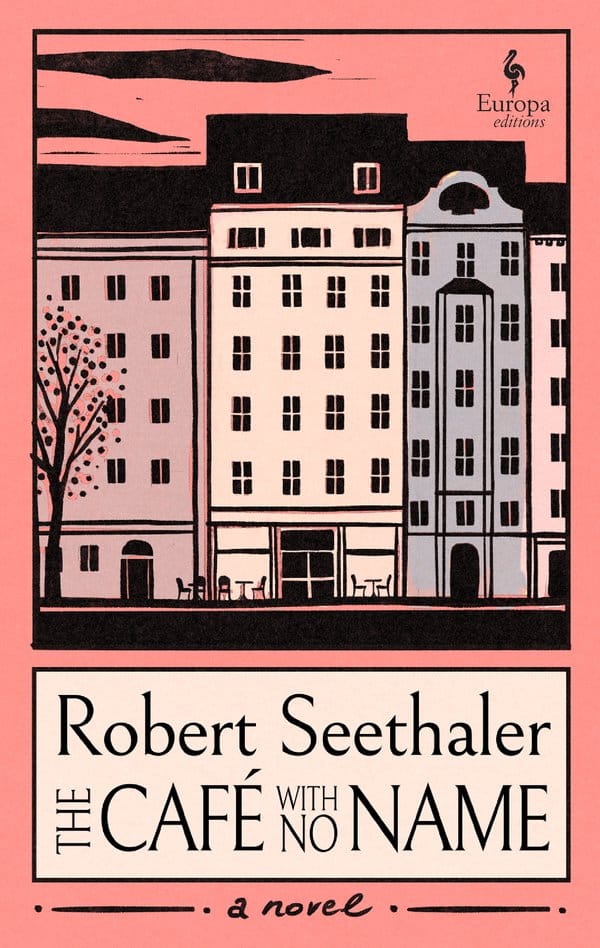
by Robert Seethaler
Today, I started reading The Café with No Name by Robert Seethaler, translated by Katy Derbyshire. It’s a vibrant story of love, companionship, and renewal in 1960s Vienna. With warm prose and tender humor, Seethaler has created a delightful parable about human existence, brought to life by unforgettable characters and a rich tapestry of narratives.
In the summer of 1966, Robert Simon was in his early thirties and had a dream. Raised in a home for war orphans, he has grown into a warm-hearted, hard-working, and determined man. When the former owners of the corner café in Carmelite Market Square close the business, Robert sees an opportunity to realize his dream.
The café, dark and dilapidated, is located in an impoverished neighborhood of the Austrian capital. However, a new energy is beginning to fill the air, signaling a desire for renewal. In the newspapers that fishmongers use to wrap char and trout from the Danube, one can read about the great things to come, heralding a bright future emerging from the shadows of the past.
Inspired by this optimism, Robert refurbishes the café. His efforts pay off as customers arrive, drawn to a congenial space where they can gather, talk, read, or sit and reflect. Each visitor brings their passion, friendship, loss, and heartache stories. Some search for companionship, while others long for love or a place to feel understood. As the city transforms, Robert’s café becomes a haven—a refuge from which to observe life, mourn, and rejoice.
Robert Seethaler was born in Vienna in 1966 and is the author of eight novels. In 2017, he was a finalist for the Man Booker International Prize with A Whole Life (FSG, 2016). He also works as an actor, most recently in Paolo Sorrentino’s Youth. He lives in Berlin.
Katy Derbyshire translates contemporary German writers, including Christa Wolf, Heike Geissler, and Olga Grjasnowa. Her translation of Clemens Meyer‘s While We Were Dreaming was longlisted for the 2023 International Booker Prize. She was born in London and has been based in Berlin for over twenty years.
When you purchase a book through one of my links, I earn a small commission that helps support my passion for reading. This contribution allows me to buy even more books to share with you, creating an incredible cycle of discovering great reads together! Your support truly makes a difference!
Enjoy a limited-time offer of 20% off your next book purchase at Bookshop.org!
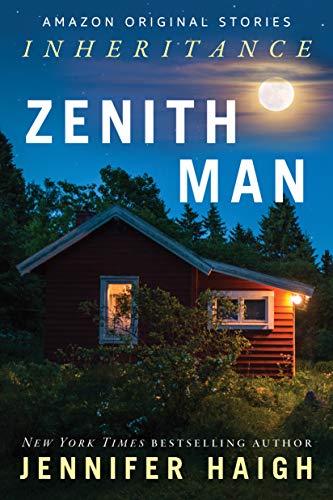
by Jennifer Haigh
Tonight I read Zenith Man by Jennifer Haigh. A 911 call begins the story. A man reports his wife had died, but no one knew he had a wife. For thirty-two years, they had been married, and only one person had seen her, but only for a minute when she said: “supper was ready.” I read the first page and immediately found myself with a short page-turner that I could not stop reading. I recommend Zenith Man.
Actual events inspired this story. For many decades, many acquaintances of Jan and mine had no idea we were married. Once they found out, the response was, “we should have known as the two of you are perfect for each other.” But they knew we were married and had met both of us.
Being a widow, I found this phrase in the story emotional and very moving.
“She was a good woman,” Harold told Cob Krug. “I was lucky to have her. I promised to keep her in sickness and in health, and that’s what I did.”
Is there anything more that can summarize the love between two people?
I highly recommend Zenith Man, part of Inheritance, a collection of five stories about secrets, unspoken desires, and dangerous revelations between loved ones. Each Inheritance piece can be read or listened to in a single setting. By yourself, behind closed doors, or shared with someone you trust. Zenith Man is the fourth one in the series I have read. The previous three were Everything My Mother Taught Me, Can You Feel This?, and The Lion’s Den.
I have enjoyed all four and look forward to reading the final one.
Now that I have read Ms. Haigh’s short story, I have added her newest novel, Mercy Street, to my queue.
The Goodreads summary provides an overview,
Whatever had been going on inside the shuttered old house, the couple who lived there kept it to themselves. Among the locals, there’s only chilling speculation.
Neighbors are shocked when Harold Pardee reports his wife dead. No one even knew the eccentric TV repairman was married. Within hours, horrible rumors spread about what that poor woman must have endured for thirty years. Until the Pardees’ carefully guarded world is exposed. New York Times bestselling author Jennifer Haigh delivers an endearing short story about our misguided perception of strangers, the nature of love, and the need for secrets.
The Jan Lilien Education Fund sponsors ongoing sustainability and environmental awareness programs. Gifts made this month; I will match dollar-for-dollar. All donations are tax-deductible.
I receive a commission when you buy a book or product using a link on this page. Thank you for supporting Sharing Jan’s Love blog.
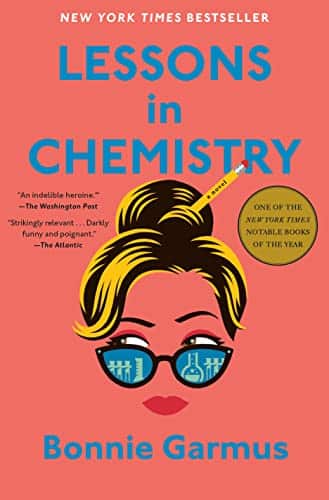
by Bonnie Garmus
Lessons in Chemistry: A Novel by Bonnie Garmus is a must-read book as it reimagines the gender dynamics of the 1950s and early 1960s. Elizabeth Zott, a chemist, struggles in a male-dominated world where her work is not taken seriously until she meets Calvin Evans. She describes their relationship, “Calvin and I were soulmates,” like Jan and I viewed ours.
What underlies their love affair was “a mutual respect for the other’s capabilities.” “Do you know how extraordinary that is?” she said. That a man would treat his lover’s work as seriously as his own?” Of course, every relationship should be based on the same dynamics, but even after seventy years, we still struggle to achieve equality in our society.
I highly recommend this novel. Reading the story, the Zott/Evans relationship reminded me of the love that Jan and I shared. I know that Jan would have loved this book.
Laugh-out-loud funny, shrewdly observant, and studded with a dazzling cast of supporting characters, Lessons in Chemistry is as original and vibrant as its protagonist. Like Jan, Elizabeth Zott, the protagonist, would be the first to point out that there is no such thing as an average woman. Chemist Elizabeth Zott is not your average woman.
Although Jan and Elizabeth had much in common, I felt Madeline (aka Mad), Elizabeth’s daughter, was Jan’s alter ego in this novel. Jan was smart and ahead of her classmates, just like Mad was. She was breaking barriers when she was Mad’s age.
I also connected to Six Thirty, the dog. Like Oscar, Six Thirty was more intelligent than the average dog.
Lessons in Chemistry has been the number one best-selling book in the New York Times for thirty-four weeks.
The Goodreads summary provides an overview,
It’s the early 1960s and Elizabeth Zott’s all-male team at Hastings Research Institute takes a very unscientific view of equality. Except for one: Calvin Evans, the lonely, brilliant, Nobel–prize-nominated grudge-holder who falls in love with—of all things—her mind. True chemistry results.
But like science, life is unpredictable. Which is why a few years later Elizabeth Zott finds herself not only a single mother, but the reluctant star of America’s most beloved cooking show Supper at Six. Elizabeth’s unusual approach to cooking (“combine one tablespoon acetic acid with a pinch of sodium chloride”) proves revolutionary. But as her following grows, not everyone is happy. Because as it turns out, Elizabeth Zott isn’t just teaching women to cook. She’s daring them to change the status quo.
The Jan Lilien Education Fund sponsors ongoing sustainability and environmental awareness programs. Gifts made this month; I will match dollar-for-dollar. All donations are tax-deductible.
I receive a commission when you buy a book or product using a link on this page. Thank you for supporting Sharing Jan’s Love blog.
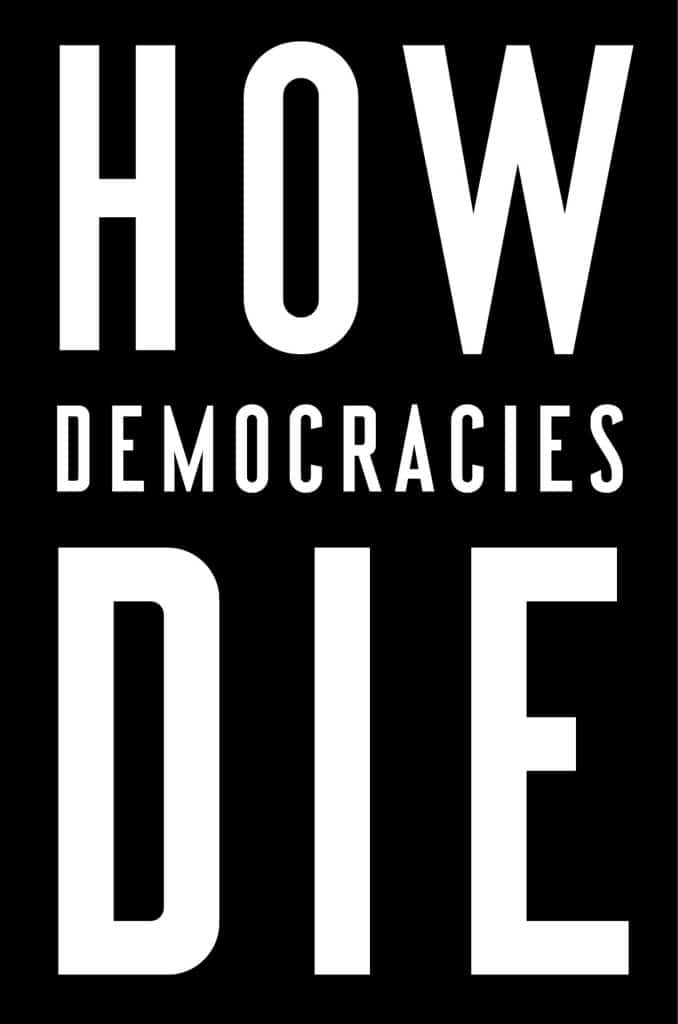
by Steven Levitsky and Daniel Ziblatt
How Democracies Die: What History Reveals About Our Future by Steven Levitsky and Daniel Ziblatt was on my reading list for almost a year. In late December of last year, I started reading it and was in the final chapter on January 6, 2021. Like many of us, I never in my life expected to see a day like that in our country.
This type of event is one the authors talk about in their book.
According to the overview in GoodReads,
Donald Trump’s presidency has raised a question that many of us never thought we’d be asking: Is our democracy in danger? Harvard professors Steven Levitsky and Daniel Ziblatt have spent more than twenty years studying the breakdown of democracies in Europe and Latin America, and they believe the answer is yes. Democracy no longer ends with a bang–in a revolution or military coup–but with a whimper: the slow, steady weakening of critical institutions, such as the judiciary and the press, and the gradual erosion of long-standing political norms. The good news is that there are several exit ramps on the road to authoritarianism. The bad news is that, by electing Trump, we have already passed the first one.
Drawing on decades of research and a wide range of historical and global examples, from 1930s Europe to contemporary Hungary, Turkey, and Venezuela, to the American South during Jim Crow, Levitsky and Ziblatt show how democracies die–and how ours can be saved.
Our democracy is too valuable for us to have it die. We all need to work to preserve and strengthen it. How Democracies Die is a book that everyone needs to read!
by Ben Jealous
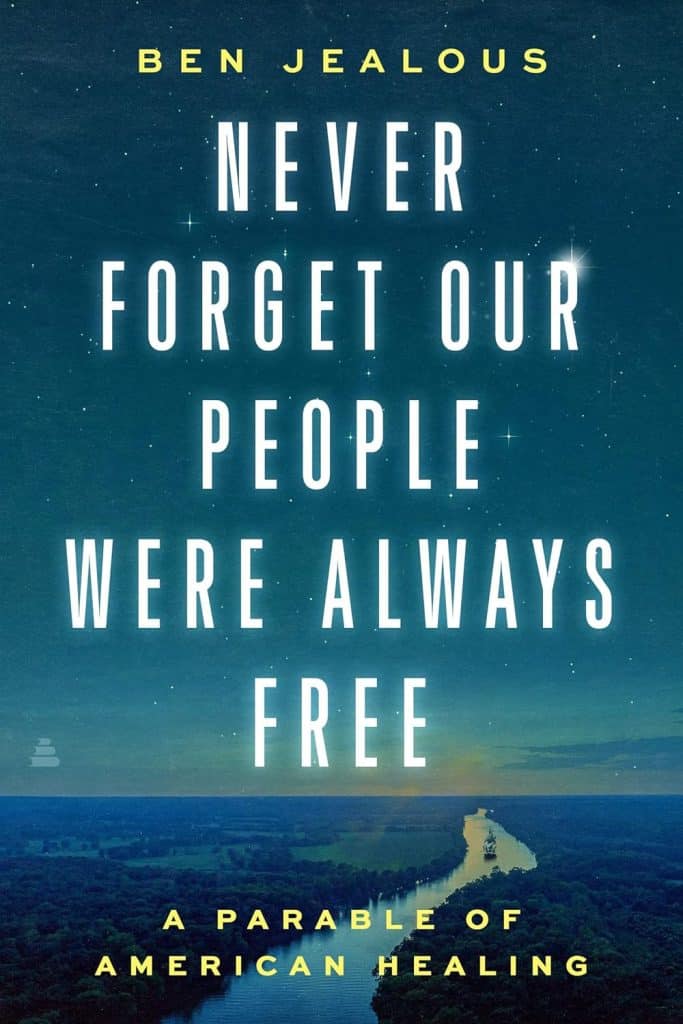
Today, I started reading “Never Forget Our People Were Always Free: A Parable of American Healing” by Ben Jealous, the Executive Director of the Sierra Club. The book highlights how the path to healing America’s broken heart begins with each of us having the courage to heal ourselves. According to Mr. Jealous, it would be transformative if every American treated each other as cousins.
Ben Jealous is the son of parents who had to leave Maryland because their cross-racial marriage was illegal.
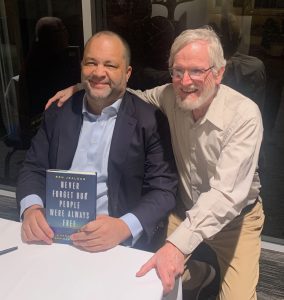
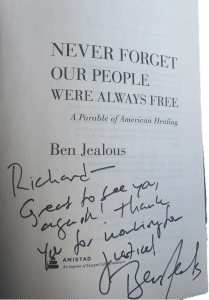
I briefly met Ben Jealous last May when I went to Washington with the Religious Action Center of Reform Judaism‘s Day of Action. When I saw Mr. Jealous speaking at Temple Emanu-El in neighboring Westfield, I immediately signed up to attend in person. He is an inspiration as an advocate for the environment, civil rights, and the healing of America’s broken heart.
His lively, courageous, and empathetic storytelling calls on every American to look past deeply cut divisions and recognize that we are all in the same boat now. Along the way, Jealous grapples with hidden American mysteries, including:
 The book Never Forget Our People Were Always Free is told through parables. It features intimate glimpses of political and faith leaders such as Jack Kemp, Stacey Abrams, and the late Archbishop Desmond Tutu. The book also highlights unlikely heroes such as a retired constable, a female pirate from Madagascar, a long-lost Irishman, a death row inmate, and a man with a Confederate flag over his heart.
Never Forget Our People Were Always Free offers readers hope that America’s oldest wounds can heal and her oldest divisions can be overcome.
Although I have only read a handful of pages of the book, I highly recommend it!
by Walt Hunter
The Singing Word: 168 Years of Atlantic Poetry, edited by Walt Hunter, celebrates the people, land, and spirit of America. This remarkable collection showcases a wide range of contemporary and historical poetry from the 168-year archive of The Atlantic magazine. Since its first issue in 1857, the poetry published in The Atlantic has drawn attention to the nation’s ongoing journey of self-discovery.
The magazine’s verse has featured odes to American leaders and landscapes, laments for the dead, and calls for change, appealing to the enduring ideals of Atlantic readers.
This one-of-a-kind collection selects poems of rousing optimism, clear-eyed realism, and moving lyricism—poems infused with the language of America’s songs, myths, and history, from the Civil War up through the present in three rich parts: National Anthems, Natural Lines, and Personal Mythologies.
Curated by The Atlantic’s Poetry Editor, this anthology features both world-famous poets—from Longfellow to Limón, including Robert Frost, W. S. Merwin, Sylvia Plath, and Adrienne Rich—as well as poets whose work has never before been published outside of the magazine.
Offering readers an essential understanding of American canon and the evolving nation, its poets have yearned to capture—the poetry of The Atlantic is the poetry of America.
Walt Hunter is a professor of twentieth- and twenty-first-century literature and chair of the English department at Case Western Reserve University. He is also the fiction and poetry editor for The Atlantic.
Discover your next favorite book and dive into a world of curated, exciting reads by purchasing through my links. You’ll have access to a diverse selection of books that I’ve personally vetted to ensure quality and enjoyment. Additionally, by supporting these selections, you’ll help me continue to provide you with more personalized recommendations. I earn a small commission from your purchase, which allows me to buy and share even more books with you. Your support truly makes a difference!