New Book: Transcription

Estimated reading time: 0 minutes, 0 seconds
Transcription

Transcription

"Transcription" by Ben Lerner has been named one of The New York Times' Best Books of the Year (So Far). Hailed as "the most talented writer of his generation" by The New York Times Magazine, Lerner presents a gripping emotional drama that also serves as a brilliant exploration of the digital and literary devices we use to store or erase our memories.

Read book review Get this book All books

The Jan Lilien Education Fund!

Transcription

Read: May 2026

Get this book

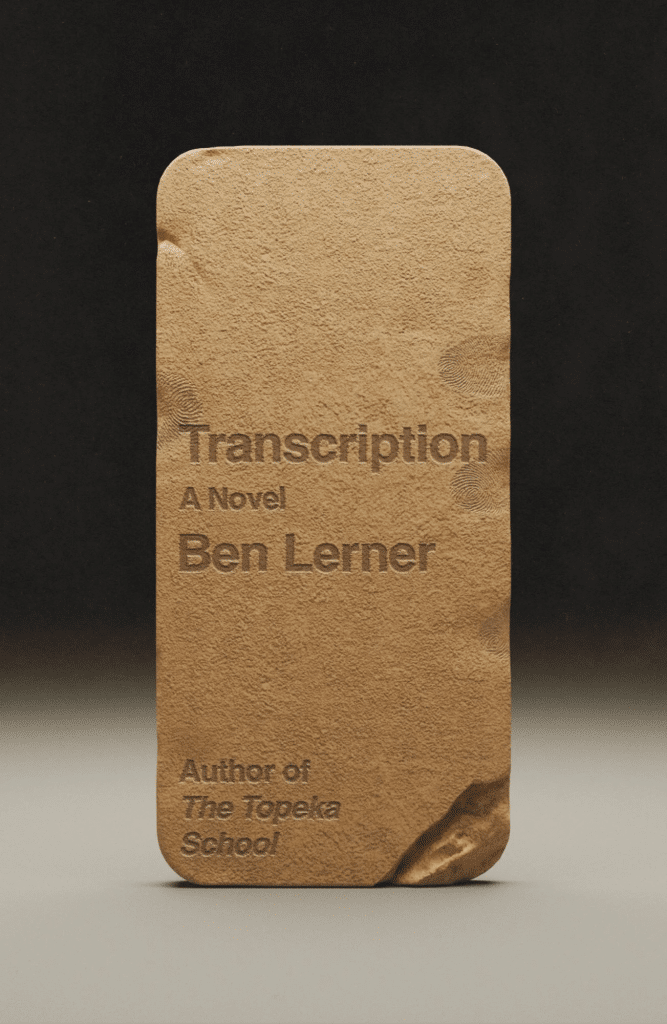
Transcription: A Novel

by Ben Lerner

Transcription” by Ben Lerner has been named one of The New York Times’ Best Books of the Year (So Far). Hailed as “the most talented writer of his generation” by The New York Times Magazine, Lerner presents a gripping emotional drama that also serves as a brilliant exploration of the digital and literary devices we use to store or erase our memories.

The narrator of Ben Lerner‘s new novel has traveled to Providence, Rhode Island, to conduct what will be the final published interview with Thomas, his ninety-year-old mentor and the father of his college friend Max. Thomas is a giant in the arts who seems to hail from the future and the past simultaneously and who reenchants the air when he speaks. But the narrator drops his smartphone in the hotel sink. He arrives at Thomas’s house without a recording device, a fact he is mysteriously unable to admit.

What unfolds from this dreamlike circumstance is the unforgettable story of the triangle formed by Thomas, Max, and the narrator, as well as an exploration of fathers and sons, male friendship and rivalry, and the challenges of parenting in a burning world. One of the first great novels about the early days of COVID, it is also a brilliant meditation on those technologies that enrich or impoverish our connection to one another, that store or obliterate memory. Full of startling insight, but summoning the intensity of a séance, Lerner’s writing shows us how the air is full of messages, full of ghosts. Ultimately, Transcription demonstrates what only a work of fiction can record.


Ben Lerner is the author of several poetry and prose books, as well as collaborative works with visual artists. He has received fellowships from the Fulbright, Guggenheim, and MacArthur Foundations. Lerner has been a finalist for the National Book Award for Poetry and the Pulitzer Prize for Fiction, along with many other honors. He is a Distinguished Professor of English at Brooklyn College.


Discover your next favorite book and dive into a world of curated, exciting reads by purchasing through my links. You’ll have access to a diverse selection of books I’ve personally vetted for quality and enjoyment. Supporting these selections not only helps me continue to provide you with personalized recommendations but also ensures you have access to meaningful stories that enrich your life. Your support truly makes a difference in helping me share more books and insights with you!


×
So Far Gone

Read: June 2025

Get this book

So Far Gone: A Novel

by Jess Walter

For the week before Father’s Day, I read So Far Gone by Jess Walter, a hilarious, empathetic, and brilliantly provocative adventure through life in modern America about a reclusive journalist forced back into the world to rescue his kidnapped grandchildren. Is this gripping tale of a grandfather’s love and determination the perfect read for the upcoming Father’s Day?

Rhys Kinnick, a character who has truly gone off the grid, provides a humorous twist to the story. At Thanksgiving a few years back, a fed-up Rhys punched his conspiracy theorist son-in-law in the mouth, chucked his smartphone out a car window, and fled for a cabin in the woods with no one around except a pack of hungry raccoons.

Now, Kinnick’s old life is about to land right back on his crumbling doorstep. Can this failed husband and father, a man with no internet and a car that barely runs, reemerge into a broken world to track down his missing daughter and save his sweet, precocious grandchildren from the members of a dangerous militia?

With the help of his caustic ex-girlfriend, a bipolar retired detective, and his only friend (who happens to be furious with him), Kinnick, a man who is struggling with his past and his present, heads off on a wild journey through cultural lunacy and the rubble of a life he thought he’d left behind. According to the Philadelphia Inquirer, So Far Gone is a rollicking, razor-sharp, and moving road trip through a fractured nation from a writer who has been called “a genius of the modern American moment.”


Jess Walter is the author of seven previous novels, including the bestsellers The Cold Millions and Beautiful Ruins, the National Book Award Finalist The Zero, and Citizen Vince, winner of the Edgar Award for best novel. His short fiction, collected in The Angel of Rome and We Live in Water, has won the O. Henry Prize and the Pushcart Prize and appeared three times in Best American Short Stories. He lives in his hometown of Spokane, Washington.


When you purchase a book through one of my links, I earn a small commission that helps support my passion for reading. This contribution allows me to buy even more books to share with you, creating an incredible cycle of discovering great reads together! Your support truly makes a difference!

Enjoy a limited-time offer of 20% off your next book purchase at Bookshop.org!


×
Lessons in Chemistry

Read: January 2023

Get this book

Lessons in Chemistry: A Novel

by Bonnie Garmus

Lessons in Chemistry: A Novel by Bonnie Garmus is a must-read book as it reimagines the gender dynamics of the 1950s and early 1960s. Elizabeth Zott, a chemist, struggles in a male-dominated world where her work is not taken seriously until she meets Calvin Evans. She describes their relationship, “Calvin and I were soulmates,” like Jan and I viewed ours.

What underlies their love affair was “a mutual respect for the other’s capabilities.” “Do you know how extraordinary that is?” she said. That a man would treat his lover’s work as seriously as his own?” Of course, every relationship should be based on the same dynamics, but even after seventy years, we still struggle to achieve equality in our society.

I highly recommend this novel. Reading the story, the Zott/Evans relationship reminded me of the love that Jan and I shared. I know that Jan would have loved this book.

Laugh-out-loud funny, shrewdly observant, and studded with a dazzling cast of supporting characters, Lessons in Chemistry is as original and vibrant as its protagonist. Like Jan, Elizabeth Zott, the protagonist, would be the first to point out that there is no such thing as an average woman. Chemist Elizabeth Zott is not your average woman.

Although Jan and Elizabeth had much in common, I felt Madeline (aka Mad), Elizabeth’s daughter, was Jan’s alter ego in this novel. Jan was smart and ahead of her classmates, just like Mad was. She was breaking barriers when she was Mad’s age.

I also connected to Six Thirty, the dog. Like Oscar, Six Thirty was more intelligent than the average dog.

Lessons in Chemistry has been the number one best-selling book in the New York Times for thirty-four weeks.

The Goodreads summary provides an overview,

It’s the early 1960s and Elizabeth Zott’s all-male team at Hastings Research Institute takes a very unscientific view of equality. Except for one: Calvin Evans, the lonely, brilliant, Nobel–prize-nominated grudge-holder who falls in love with—of all things—her mind. True chemistry results.

But like science, life is unpredictable. Which is why a few years later Elizabeth Zott finds herself not only a single mother, but the reluctant star of America’s most beloved cooking show Supper at Six. Elizabeth’s unusual approach to cooking (“combine one tablespoon acetic acid with a pinch of sodium chloride”) proves revolutionary. But as her following grows, not everyone is happy. Because as it turns out, Elizabeth Zott isn’t just teaching women to cook. She’s daring them to change the status quo.


The Jan Lilien Education Fund sponsors ongoing sustainability and environmental awareness programs. Gifts made this month; I will match dollar-for-dollar. All donations are tax-deductible.

Subscribe

Contact Us

I receive a commission when you buy a book or product using a link on this page. Thank you for supporting Sharing Jan’s Love blog.


×
Fourteen Days: A Collaborative Novel

Read: February 2024

Get this book

Fourteen Days: A Collaborative Novel

by Authors Guild

I started reading Fourteen Days: A Collaborative Novel today. It is set in a Lower East Side tenement during the early days of the COVID-19 lockdowns. Fourteen Days is a unique collaborative novel from the Authors Guild with a twist. A different, prominent literary voice has secretly written each character in this diverse cast of New York neighbors. These voices range from Margaret Atwood and Celeste Ng to Tommy Orange and John Grisham.

The novel’s story begins one week into the COVID-19 shutdown, where tenants of a Lower East Side apartment building in Manhattan have gathered on the rooftop to tell stories. As the nights pass, more and more neighbors join in, bringing chairs, milk crates, and overturned pails. Gradually, the tenants, some of whom have barely spoken to each other, become neighbors.

In this Decameron-like serial novel, general editors Margaret Atwood and Douglas Preston and a star-studded list of contributors create a beautiful ode to those trapped when the pandemic hit. Fourteen Days is a dazzling, heartwarming, and ultimately surprising narrative that reveals how some communities managed to become stronger despite the loss and suffering brought about by the pandemic.

Includes writing from: Charlie Jane Anders, Margaret Atwood, Joseph Cassara, Jennine Capó Crucet, Angie Cruz, Pat Cummings, Sylvia Day, Emma Donoghue, Dave Eggers, Diana Gabaldon, Tess Gerritsen, John Grisham, Maria Hinojosa, Mira Jacob, Erica Jong, CJ Lyons, Celeste Ng, Tommy Orange, Mary Pope Osborne, Douglas Preston, Alice Randall, Ishmael Reed, Roxana Robinson, Nelly Rosario, James Shapiro, Hampton Sides, R.L. Stine, Nafissa Thompson-Spires, Monique Truong, Scott Turow, Luis Alberto Urrea, Rachel Vail, Weike Wang, Caroline Randall Williams, De’Shawn Charles Winslow, and Meg Wolitzer!

×
The God of the Woods: A Novel

Read: July 2024

Get this book

The God of the Woods: A Novel

by Liz Moore

I started reading “The God of the Woods: A Novel” by Liz Moore today. Several reviews recommended it as a great summer read. The story is set in August 1975, the same month and year my spouse Jan and I married. Liz Moore weaves a multi-threaded story, inviting readers into a rich and gripping dynasty of secrets and second chances.

The novel begins with a camp counselor discovering an empty bunk at an Adirondack summer camp belonging to thirteen-year-old Barbara Van Laar, who has mysteriously vanished. Barbara is not just any teenager; she is the daughter of the family that owns the camp and employs many residents. What makes this disappearance even more intriguing is that Barbara’s older brother went missing similarly fourteen years ago and was never found.

As the search for Barbara begins, the novel unfolds into a thrilling drama, delving into the deeply buried secrets of the Van Laar family and the blue-collar community working in its shadow. This novel is said to be Liz Moore’s most ambitious and wide-reaching work yet.

×
Revolutionary Mothers

Read: February 2019

Get this book

Revolutionary Mothers

by Carol Berkin

Revolutionary Mothers by Carol Berkin, Presidential Professor of American Colonial and Revolutionary History; Women’s History Professor at Baruch College, is one of four books I purchased after my first One Day University Class on February 9, 2019. It should be required reading!

The book explains how women of the Revolution were most active at home, organizing boycotts of British goods, raising funds for the fledgling nation, and managing the family business while struggling to maintain a modicum of normalcy as husbands, brothers, and fathers died.

It was not just the men who fought on the front lines, as in the story of Margaret Corbin, who was crippled for life when she took her husband’s place beside a cannon at Fort Monmouth. She explains the mystery of Molly Pitcher (she was not a person but a group of women), camp followers, women who spied for their country, Loyalist women, and the impact on African American and Native women.

This intelligent and comprehensive history brings these forgotten stories to their rightful place in the struggle for American independence. Dr. Birkin also highlights how their efforts set the stage for the continuing campaign for gender equality.

Subscribe

Contact Us

×
When We Cease to Understand the World

Read: September 2024

Get this book

When We Cease to Understand the World

by Benjamín Labatut

Today, I began reading When We Cease to Understand the World by Benjamín Labatut, translated by Adrian Nathan West. This book, listed on The New York Times 100 Best Books of the 21st Century, promises to be thought-provoking as it delves into the intricate connections between scientific and mathematical discovery, madness, and destruction.

In a world where scientific advancements often involve ethical dilemmas and societal implications, this book offers a unique perspective on the lives of scientists who have shaped our understanding of the world. Fritz Haber, Alexander Grothendieck, Werner Heisenberg, and Erwin Schrödinger are some of the luminaries whose troubled lives Benjamín Labatut deeply explores in his fictional examination. Labatut shows how these scientists and thinkers grappled with profound questions of existence, experiencing strokes of unparalleled genius, alienating friends and lovers, and descending into isolation and insanity. Their discoveries, some of which significantly improved human life, while others led to chaos and unimaginable suffering, continue to shape our world.

With a breakneck pace and a wealth of disturbing detail, Labatut uses fiction’s imaginative resources to tell the stories of the scientists and mathematicians who expanded our notions of the possible.

×