
Brave Enough to See the Light

Brave Enough to See the Light

Brave Enough to Be the Light

Estimated reading time: 1 minute, 3 seconds

Amanda GormanI struggle to see the light and find my way as I live as a stranger in a strange land.

I was unmoored and adrift in troubled waters in my first hours as a widow.

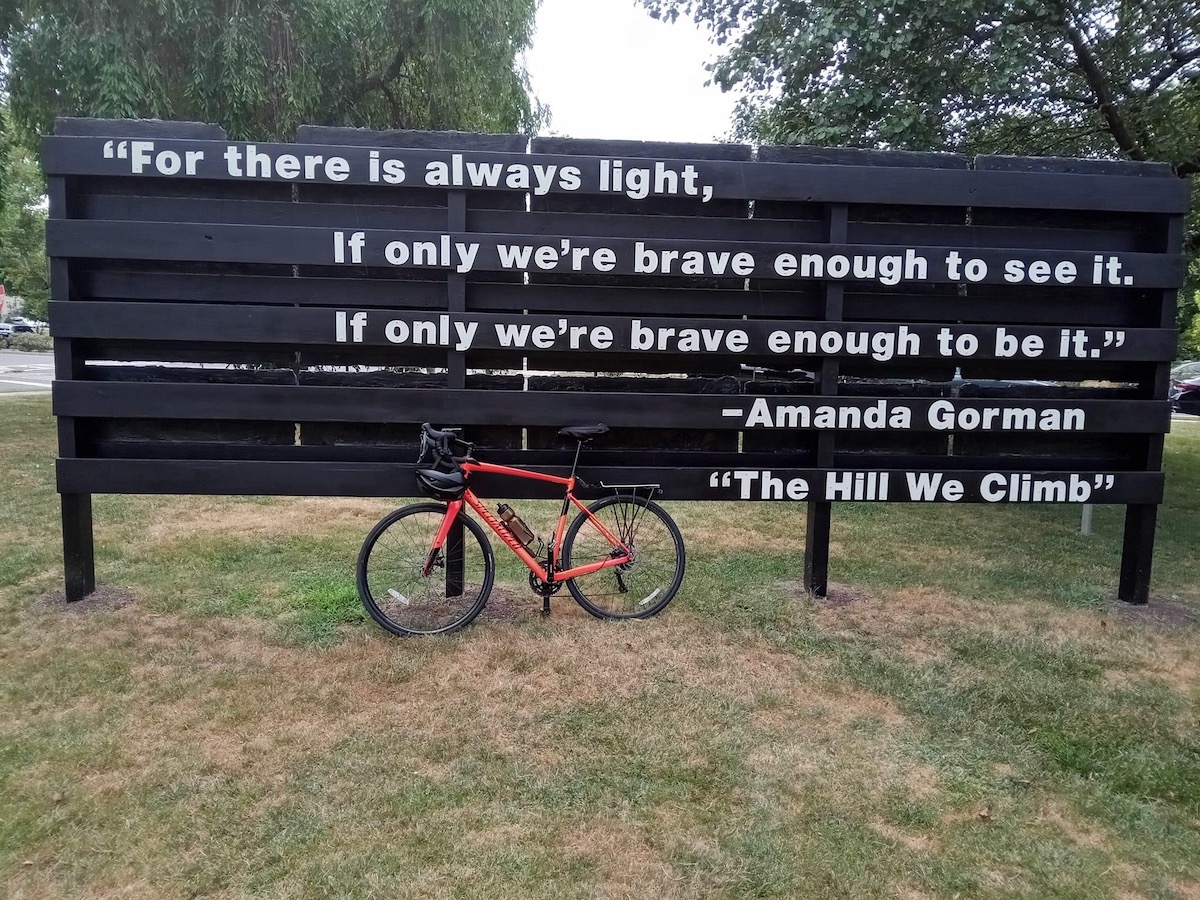
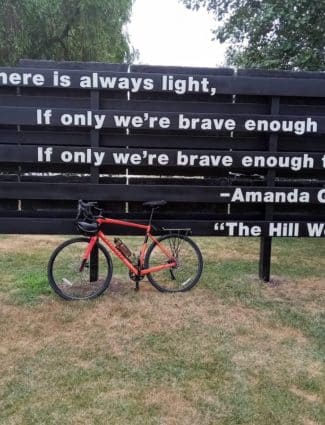
One of the touchstones that helped me see the light was Amanda Gorman‘s poem “The Hill We Climb.”

The closing stanza reminded me that I must only be brave enough to see and be it.

For there is always light,
if only we’re brave enough to see it
If only we’re brave enough to be it.

Am I brave enough?

My daily goal is to see the light and be the light!

In this new phase of my life, I know that Jan wants me to be brave and be the light.

The only self-evident truth I know is that the love Jan and I shared will never die!


The Jan Lilien Education Fund sponsors ongoing sustainability and environmental awareness programs. Gifts made this month; I will match dollar-for-dollar. All donations are tax-deductible.

Subscribe

Contact Us

I receive a commission when you buy a book or product using a link on this page. Thank you for supporting Sharing Jan’s Love blog.
Jan Whispers Words of Wisdom

With raindrops falling on my head, I hear Jan whispering words of wisdom. When I find myself in times of trouble Mother Mary comes to me Speaking words of wisdom, let it be. And in my hour of darkness She is standing right in front of me Speaking words of wisdom, let it be. Let […]

Share your thoughts and ideas

This site uses Akismet to reduce spam. Learn how your comment data is processed.

The Jan Lilien Education Fund!

Brave Enough to See the Light
×
How Democracies Die

Read: January 2021

Get this book

How Democracies Die: What History Reveals About Our Future

by Steven Levitsky and Daniel Ziblatt

How Democracies Die: What History Reveals About Our Future by Steven Levitsky and Daniel Ziblatt was on my reading list for almost a year. In late December of last year, I started reading it and was in the final chapter on January 6, 2021. Like many of us, I never in my life expected to see a day like that in our country.

This type of event is one the authors talk about in their book.

According to the overview in GoodReads,

Donald Trump’s presidency has raised a question that many of us never thought we’d be asking: Is our democracy in danger? Harvard professors Steven Levitsky and Daniel Ziblatt have spent more than twenty years studying the breakdown of democracies in Europe and Latin America, and they believe the answer is yes. Democracy no longer ends with a bang–in a revolution or military coup–but with a whimper: the slow, steady weakening of critical institutions, such as the judiciary and the press, and the gradual erosion of long-standing political norms. The good news is that there are several exit ramps on the road to authoritarianism. The bad news is that, by electing Trump, we have already passed the first one.

Drawing on decades of research and a wide range of historical and global examples, from 1930s Europe to contemporary Hungary, Turkey, and Venezuela, to the American South during Jim Crow, Levitsky and Ziblatt show how democracies die–and how ours can be saved.

Our democracy is too valuable for us to have it die. We all need to work to preserve and strengthen it. How Democracies Die is a book that everyone needs to read!

Subscribe

Contact Us

×
Killing Stella

Read: July 2025

Get this book

Killing Stella

by Marlen Haushofer

Yesterday, I read “Killing Stella,” written by Marlen Haushofer and translated by Shaun Whiteside, which is a domestic horror story that culminates in an apocalyptic ending. This novella captures many of the themes present in Haushofer’s acclaimed novel, “The Wall,” presenting them within a claustrophobic, gothic, and striking narrative. It offers a gripping and incisive exploration of a fractured marriage, highlighting the remarkable talent of the author of “The Wall,” now available in English for the first time.

Main description: Left alone for the weekend while her husband and two children visit her in-laws, the narrator of “Killing Stella” recounts the addition of her friend’s daughter, Stella, to their already tense and tumultuous household. As she stares out the window at her garden, she worries about a baby bird in the linden tree, her husband Richard, who flits from one adulterous affair to another, her son’s gloomy demeanor, and her daughter’s obliviousness to everything. Most of all, she worries about Stella, a confused teenager who has met a sudden and disastrous end.


Marlen Haushofer (1920–1970) was an Austrian author known for her short stories, novels, radio plays, and children’s books. Her work has significantly influenced many German-speaking writers, including Nobel Prize winner Elfriede Jelinek, who dedicated one of her plays to Haushofer. One of her most notable works, “The Wall“, was adapted into a film in 2012, directed by Julian Pölsler and starring Martina Gedeck.

Shaun Whiteside is known for his translations of classic works from German, including those by Freud, Musil, and Nietzsche.


When you purchase a book through one of my links, I earn a small commission that helps support my passion for reading. This contribution allows me to buy even more books to share with you, creating an incredible cycle of discovering great reads together! Your support truly makes a difference!

Enjoy a limited-time offer of 20% off your next book purchase at Bookshop.org!


×
The Catch

Read: June 2025

Get this book

The Catch: A Novel

by Yrsa Daley-Ward

In “The Catch,” her captivating debut novel, Yrsa Daley-Ward creates a vibrant multiverse that delves into the complexities of daughterhood and mother-want. She explores the sacrifices women often make in their pursuit of self-actualization. The result is a remarkable novel that boldly poses the question: “How can it ever be a crime to choose yourself?”

Twin sisters Clara and Dempsey have always struggled to connect, their familial bond severed after their mother vanished into the Thames. As infants, they were adopted by different families: Clara went to live with a successful, upper-class couple, while a distant and unaffectionate city councilor took in Dempsey. As adults, the sisters have settled into a comfortable estrangement until Clara spots a woman on the streets of London who looks exactly like their mother. The twist? This version of Serene appears ageless and has lived a childless life — the very life she might have had if the girls had never been born.

As with most things, Clara and Dempsey cannot agree on the strange appearance of this woman. Clara, a celebrity author with a penchant for excessive drinking and one-night stands, is eager to welcome the confident and temperamental Serene into her home. In contrast, reclusive Dempsey, who makes a modest living doing menial data entry work from her apartment, is suspicious of the entire situation, believing it to be a cunning scheme by a con woman.

As the sisters clash over this stranger who increasingly intrudes into their lives, they hurtle toward a confrontation that threatens their very existence, ultimately forcing them to face their shared past together.


Yrsa Daley-Ward is a poet, writer, and actress. She is the author of The Howbone, and The Terrible, for which she won the PEN Ackerley Prize. She lives in Los Angeles.


When you purchase a book through one of my links, I earn a small commission that helps support my passion for reading. This contribution allows me to buy even more books to share with you, creating an incredible cycle of discovering great reads together! Your support truly makes a difference!

Enjoy a limited-time offer of 20% off your next book purchase at Bookshop.org!


×
How to Commit a Postcolonial Murder

Read: January 2026

Get this book

How to Commit a Postcolonial Murder

by Nina McConigley

How to Commit a Postcolonial Murder” by Nina McConigley is a bold, inventive, and fiercely original debut novel. The story begins with the death of an uncle and features his tween niece’s private confession to the reader—she and her sister are responsible for his death, and they blame the British. The New York Times has listed it as one of “The Novels Everyone Will Be Talking About in 2026.”

Summer, 1986. The Creel sisters, Georgie Ayyar, and Agatha Krishna, welcome their aunt, uncle, and young cousin—newly arrived from India—into their house in rural Wyoming, where they’ll all live together. Because this is what families do, that is, until the sisters decide that it’s time for their uncle to die.

According to Georgie, the British are to blame. And to understand why, you need to hear her story. She details the violence hiding in their house and history, her once-unshakeable bond with Agatha Krishna, and her understanding of herself as an Indian-American in the heart of the West. Her account is, at every turn, cheeky, unflinching, and infectiously inflected with the trappings of teendom, including the magazine quizzes that help her make sense of her life. At its heart, the tale she weaves is:

a)    a vivid portrait of an extended family
b)    a moving story of sisterhood
c)    a playful ode to the 80s
d)    a murder mystery (of sorts)
e)    an unexpected and unwaveringly powerful meditation on history and language, trauma and healing, and the meaning of independence

Or maybe it’s really:

f)      all of the above.


Nina McConigley is the author of the story collection Cowboys and East Indians, which won the PEN Open Book Award and the High Plains Book Award. She has received grants and fellowships from the National Endowment for the Arts (NEA), the Radcliffe Institute, the Bread Loaf Writers’ Conference, the Vermont Studio Center, and the Sewanee Writers’ Conference.

McConigley was awarded the Wyoming Arts Council’s Frank Nelson Doubleday Memorial Writing Award and was a finalist for a National Magazine Award for her columns in High Country News. Her work has appeared in several prominent publications, including The New York Times, Orion, O: The Oprah Magazine, and The Virginia Quarterly Review.

Born in Singapore and raised in Wyoming, she currently resides in Colorado.


Discover your next favorite book and dive into a world of curated, exciting reads by purchasing through my links. You’ll have access to a diverse selection of books I’ve personally vetted for quality and enjoyment. Additionally, by supporting these selections, you’ll help me continue to provide you with more personalized recommendations. I earn a small commission from your purchase, which allows me to buy and share even more books with you. Your support truly makes a difference!


×
Breathe

Read: September 2021

Get this book

Breathe

by Joyce Carol Oates

Celebrate JanReading Breathe by Joyce Carol Oates was a book I knew I needed to read once Jan was diagnosed. Although the book might trigger negative memories, I finally read Breathe. It was what I needed to read at this point in my journey.

Ms. Oates wrote the book in 2019 after her husband, Charlie Gross, died. The novel is a story of love, loss, and loneliness, topics that I write about on this blog. I needed to read the book both for my mental health and for the readers of Sharing Jan’s Love.

The protagonist, Michaela, loses her husband while they are on a sabbatical in New Mexico. Her husband, Gerard, writes a book and teaches a class on memories. Jan and I never considered relocating before her illness, but this book convinced me that it would have aggravated my grief journey.

One of the parallels I observed while reading the novel is the similarity between Gerard’s reluctance to let family, friends, and co-workers know of his illness. Jan shared that reluctance in the early days, but I convinced her that the only chance of beating cancer was with the help of family and friends.

This dialogue could easily be one that Jan and I had.

Of course you want to summon his family—his (adult) children—but quickly, he says no.

Still waiting.

But – When?

Just not yet.

He is not an alarmist. (You are the alarmist.)

The novel is written in two parts – The Vigil and the Post-Mortem.

The opening paragraphs set the tone.

A Hand is gripping yours. Warm, dry hand gripping your slippery, humid hand.

Whoever it is urging you – Breathe!

Leaning over you begging you – Breathe!

As one mourning the death of the love of his life, I found several phrases in the book helpful in understanding what I have gone through and will continue to confront.

Among them is grief-vise, which I have written about in this stream.

In the grip of the grief vise, all that you will do, all that you even imagine doing, will require many times more effort.. Hardly daring to breathe for the grief-vise will tighten around your chest, squeezing the very air out of your lungs.

In the early stages of grief, the vise was strangling me. Breathing was impossible, and weeping was constant at times.

Michaela struggles with her grief. Seeing her husband every time she sees a man alone, even if they are older or younger than he was. I know I have felt Jan’s presence and still expect her to walk into our apartment.

Her struggles with a grief counselor and overly helpful friends are an experience I have not had but are familiar to those suffering from losing a loved one.

The last chapters are ones in which time becomes confusing and chaotic. At times, I was uncertain about which were real or imagined. The end, like all good novels, was ambiguous.

These are some of the other phrases I have found useful and will include in posts.

  • If there is no one to love, do we merit existence?
  • Never come to the end of kissing.
  • The first principle of life is; Breathe.
  • Shy in the language of intimacy.
  • As if a life lived with strangers could compensate for the emptiness in your heart.
  • No purpose in your life. No compass.

What you love most, that you will lose. The price of your love is your loss.

I recommend this book to all readers, even those struggling with grief.

Subscribe

Contact Us

When you buy a book or product using a link on this page, I receive a commission. Thank you for supporting Sharing Jan’s Love blog.

×
Self-Portrait with Ghost: Short Stories

Read: December 2022

Get this book

Self-Portrait with Ghost: Short Stories

by Meng Jin

Self-Portrait with Ghost: Short Stories by Meng Jin was written during the turbulent years of the Trump administration and the first year of the pandemic, these stories explore intimacy and isolation, coming of age, and coming to terms with the repercussions of past mistakes, fraying relationships, and surprising moments of connection. I highly recommend Self-Portrait with Ghost: Short Stories!

Each story speaks so clearly to the loneliness epidemic that confronts our world. I would read one short story and promise to stop and wait until another day to read the next one. Instead

One phrase that will always remain with me is: “The hallucinatory quality of grief.” As a widow, the phrase struck a chord that will forever resonate in my soul.

This is the seventy-third book I have read this year.

The Goodreads summary provides an overview,

Meng Jin’s critically acclaimed debut novel, Little Gods, was praised as “spectacular and emotionally polyphonic (Omar El-Akkad, BookPage), “powerful” (Washington Post), and “meticulously observed, daringly imagined” (Claire Messud). Jin turns her considerable talents into short fiction in ten thematically linked stories.

Moving between San Francisco and China, and from unsparing realism to genre-bending delight, Self-Portrait with Ghost considers what it means to live in an age of heightened self-consciousness, seemingly unlimited access to knowledge, and little actual power.

Page-turning, thought-provoking, and wholly unique, Self-Portrait with Ghost further establishes Meng Jin as a writer who “reminds us that possible explanations in our universe are as varied as the beings who populate it” (Paris Review).


The Jan Lilien Education Fund sponsors ongoing sustainability and environmental awareness programs. Gifts made this month; I will match dollar-for-dollar. All donations are tax-deductible.

Subscribe

Contact Us

I receive a commission when you buy a book or product using a link on this page. Thank you for supporting Sharing Jan’s Love blog.


×